



REVESCO. Revista de Estudios Cooperativos. ARTÍCULOS
e-ISSN: 1985-8031
Ana María García Pérez
Dpto. Dirección de
Empresas e Historia Económica, Universidad de La Laguna (España) 

Vanessa Yanes Estévez
Dpto. Dirección de
Empresas e Historia Económica, Universidad de La Laguna (España)
Cándido Román Cervantes
Dpto. Dirección de
Empresas e Historia Económica, Universidad de La Laguna (España)
Enrique González Dávila
Dpto. Matemáticas,
Estadística e Investigación Operativa, Universidad de La Laguna (España)
https://dx.doi.org/10.5209/REVE.93672 Recibido: 13/06/2023 • Aceptado: 20/12/2023 • Publicado: 05/02/2024
ES Resumen. Entre otros factores, los resultados y la competitividad de las cooperativas agroalimentarias dependen de su estrategia (Bijman, 2012; Mckee, 2008; Pashkova, et al., 2009). Esta investigación profundiza en el comportamiento estratégico de las cooperativas siguiendo la tipología estratégica de Miles y Snow (1978). Una contribución importante es que el estudio considera el ajuste (el ciclo adaptativo) dentro y entre las características o problemas que definen el comportamiento estratégico de las cooperativas: problema emprendedor, tecnológico y administrativo. Directivos de cooperativas agroalimentarias de Canarias (España) respondieron a un cuestionario que proporcionó la información necesaria para realizar el análisis. Los resultados muestran que las cooperativas agroalimentarias adoptan un comportamiento estratégico analizador o híbrido que busca equilibrar la eficiencia y el control de costes con la innovación. No se encontraron diferencias significativas en ninguno de los problemas estratégicos en función del tamaño de la cooperativa. Sin embargo, sí surgen diferencias en algunos de los ítems cuando se analizan individualmente. Por ejemplo, en las microempresas, los puestos directivos más altos tienden a estar ocupados más por socios que han promocionado desde dentro de la cooperativa que por profesionales externos. Existe un elevado ajuste estratégico dentro del problema emprendedor, pero bastante escaso ajuste entre este problema y los demás. La planificación estratégica de las cooperativas presenta un ajuste inverso con su organización y con su ámbito de actividad. La tecnología no parece estar alineada con los demás problemas estratégicos, especialmente en lo que respecta a varios aspectos relacionados con el problema administrativo. Así pues, la planificación parece ser el principal punto débil de estas organizaciones. En este trabajo se consideran explícitamente los tres problemas de la tipología de Miles y Snow (1978) y las relaciones entre ellos. Esto nos permite aproximarnos al grado de alineamiento o ajuste entre ellos y llenar así el vacío existente en la literatura estratégica con respecto a las cooperativas.
Palabras clave. Cooperativas, estrategia, tipología estratégica, ciclo adaptativo, comportamiento estratégico.
Claves Econlit. M10, Q13.
ENG The strategic behaviour of cooperatives: their adaptive cycle
ENG Abstract. Among other factors, the performance and competitiveness of agri-food cooperatives depend on their strategy (Bijman, 2012; Mckee, 2008; Pashkova, et al., 2009). This research explores the strategic behaviour of cooperatives in depth following the strategic typology of Miles and Snow (1978). One important contribution is that the study considers the fit (the adaptive cycle) within and between the features or problems that define cooperatives’ strategic behaviour; entrepreneurial, technological, and administrative problems. Managers of agri-food cooperatives in the Canary Islands (Spain) answered a questionnaire which provided the information needed to make the analysis. The results show that agri-food cooperatives adopt an analyser or hybrid strategic behaviour that seeks to balance efficiency and cost control with innovation. No significant differences were found in any of the strategic problems related to cooperative size. However, differences do emerge in some of the items when analysed individually. For example, in microenterprises, higher management positions tend to be occupied more by members who are promoted from within than by external professionals. There is a high strategic fit within the entrepreneurial problem, but quite a scant fit between this problem and the others. Cooperatives' strategic planning presents an inverse alignment with their organisation and activity scope. Technology does not seem to be aligned with the other strategic problems, especially vis-à-vis several aspects related to the administrative problem. Planning thus seems to be these organisations’ main weakness. In this paper, the three problems of the Miles and Snow (1978) typology are explicitly considered as are the relations between them. This allows us to approach the degree of alignment or fit between them and thus fill the existing gap in management literature with regard to cooperatives.
Keywords. Cooperatives, strategy, strategic typology, adaptive cycle, strategic behaviour.
Summary. 1. Introduction. 2. Theoretical framework. 3. Research design. 4. Results. 5. Conclusions, implications and future research lines. 6. References.
How to cite: García Pérez, A.M.; Yanes Estévez, V.; Román Cervantes, C. & González Dávila, E. (2024). The strategic behaviour of cooperatives: their adaptive cycle. REVESCO. Revista de Estudios Cooperativos, 146(1), 1-18, e93672. https://dx.doi.org/10.5209/REVE.93672.
Agri-food cooperatives play a key social and economic role in the agri-food sector (Sánchez-Navarro, Arcas-Lario and Hernández-Espallardo, 2023). As a result, these organisations fulfil a dual purpose by simultaneously acting both as a business and as a union of members (Mazzarol, Clark, Rebouds and Limnios, 2018) in which a number of diverse roles, similar interests and close-knit relationships merge. The two-fold nature of cooperatives may explain why such little academic attention has focused on these organisations in the field of management sciences or core business disciplines (Mazzarol et al., 2018), with greater attention having been paid to the nature of these organisations and their social role, despite the fact that they are also businesses and, as such, must seek to maximize their members’ profits (Sánchez-Hernández and Castilla-Polo, 2021).
As a result, studies into the strategic and competitive issues linked to these organisations are fragmented and centre on very specific aspects thereof, whilst failing to provide a global or integrating view. The literature offers studies that address these organisations’ market competitiveness (Lajara-Camilleri and Server-Izquierdo, 2017), the disperse nature of their members (for example, Höler and Kuhl, 2018), the role they play in the supply chain (for example, Bijman, Muradian and Cechin, 2011; Höhler and Kühl, 2014; Zhong, Zhang, Jia and Bijman, 2018), member participation in management bodies (for example, Cechin, Bijman, Pascucci, Zylbersztajn and Omta, 2013), how size impacts their performance (for example, Bijman, 2012; Mckee, 2008; Pashkova, Niklis, Alexakis and Papandreou, 2009), the importance of their social capital and their link to various cooperative aspects (for example, Bretos, Díaz-Foncea, Marcuello and Marcuello, 2018; Liang, Lu and Deng, 2018; Yu and Nilsson, 2018), their particular features when compared to other organisations (for example, Fernando, Garnevska, Milan and Shadbolt, 2021) or how mergers between cooperatives impact their performance (for example, Melia-Martí and Martínez-García, 2015).
The study of cooperatives’ strategic behaviour –as a source of competitiveness– has received surprisingly little attention, as pointed out by authors such as Carr, Kariyawasam and Casil (2008) or Mazzarol (2009). Despite this, the few studies that have indeed addressed this issue have concluded that the performance and competitiveness of agri-food cooperatives depend, among other factors, on their strategy (Bijman, 2012; Mckee, 2008; Pashkova, et al., 2009). As a result, this strategic approach must perforce be applied to cooperatives (Sanchís Palacio, 2001) since –amongst other aspects– the environment in which they operate in no way differs from that in which other organisations also operate (Castilla-Polo, Sánchez-Hernández and Gallardo-Vázquez, 2017).
This paper helps to fill this gap by enabling us to learn more about cooperatives’ strategic management through the application of the Miles and Snow (1978) typology. This typology is among the most widely used, and allows a wide array of theoretical and empirical strategic approaches to be applied to a range of sectors (for example, financial industry, non-financial, service, retail, tourism or multisector samples) and types of company (Anwar and Hasnu, 2016; Anwar, Hasnu, Butt and Ahmed, 2021). In this case, it is applied to agri-food cooperatives.
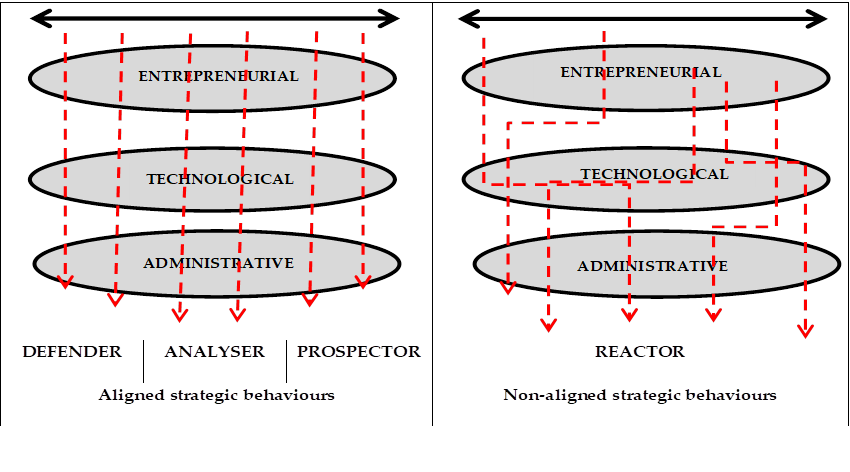
One of the keys to the strategic typology of Miles and Snow (1978) is that it addresses how firms adapt several aspects of their management to different circumstances. This typology examines how the company faces its entrepreneurial problem (what products it offers and what markets it serves), its technological problem (what technology it uses to obtain and market its products) and its administrative problem (what organisational characteristics are suitable for that technology and those products-markets). The fit between these three areas of action and the company’s decision-making constitute what Miles and Snow (1978) call the adaptive cycle[1]. What makes this typology superior to other proposals is precisely its adaptive cycle (Anwar et al., 2021). This typology suggests four types of strategic behaviours that emerge as a result of the decisions taken about these three problems or their adaptive cycle. Depending on how they fit and align, firms will thus adopt a more prospector, analyser, defender or reactor strategic behaviour. Firms that perform best will be those that present an internal fit between these three problems (Blumentritt and Danis, 2006); hence the importance of examining such problems and their alignment. This paper thus seeks to provide an in-depth study of cooperatives’ strategic behaviour, focusing on the fit within and between the entrepreneurial, technological and administrative problems of the Miles and Snow strategic typology (1978).
This work thus makes two important contributions with its analysis of the strategic behaviour of agri-food cooperatives when applying one of the most extended typologies: the typology of Miles and Snow (1978). Firstly, the few works that do address the strategic behaviour of cooperatives have done so in a global and theoretical way (for example, Kyriakopoulos and Van Bekkum, 1999), or in a very specific way (Zhong et al., 2018), yet have barely done so in empirical terms by delving into the complexity of the strategic behaviour adopted by agri-food cooperatives. Secondly, many of the previous works that apply the typology of Miles and Snow (1978) do not take into account cooperatives’ adaptive cycle in detail, and thus ignore the theoretical foundation of the strategic types (Anwar et al, 2021). As a result, many papers use only one strategic problem or do not differentiate clearly between them. The three problems are thus assumed to be one single global reality (Frambach, Fiss and Ingenbleek, 2016; Ingram, Krasnicka, Wronka-Pospiech, Glod, and Glod, 2016) and, therefore, are deemed to fit perfectly. This article explicitly considers the three problems, focusing special attention on their relations, and thereby providing a more detailed analysis. This allows us to approach the degree of alignment or fit between them and to open the “black box” of the adaptive cycle. This is the main contribution of this work to strategic management literature and to the literature on cooperatives.
This article is organised as follows. The next section focuses on the theoretical background of this research and the hypotheses. The third section provides the methodology, with the data collection and scales. The results are presented in the fourth section and, finally, the last section presents the conclusions, implications and future research lines.
2.1. The strategic typology of Miles and Snow (1978)
The strategic typology of Miles and Snow (1978) is one of the most important in the strategic management field (Dent, 1990; Hambrick, 2003; Bouhelal and Kerbouche, 2016; Ingram et al., 2016). It has been applied to SMEs in Australia (Blackmore and Nesbitt, 2013), strategic business units in the USA (DeSarbo, Di Benedetto, Song and Sinha, 2016), tourist firms in Turkey (Avci, Madanoglu and Okumus, 2011), state-owned enterprises in Indonesia (Apriyantopo, Aprianingsih and Kitri 2022), electronic and engineering firms in the UK (O’Regan and Ghobadian, 2006), or manufacturing enterprises in Poland (Ingram et al, 2016) [2]. This widespread application in multiple contexts and types of companies evidences its adaptability to different and varied scenarios and its universality (Bouhelal and Kerbouche, 2016). Another sign of its adequacy is its ever-increasing demand (Anwar et al., 2021), even in the digital age (Kurtz, Hanelt and Kolbe, 2021). This typology is thus considered unique because it defines organisations as “an integrated and dynamic whole” (Anwar et al., 2021) in interaction with their environment (Gnjidić, 2014)[3] and within a theoretical base of co-alignment (Conant, Mokwa and Varadarajan., 1990).
Miles and Snow (1978) defined four types of strategic behaviour (prospector, analyser, defender, and reactor) as a result of an adaptive process (called the adaptive cycle) of the entrepreneurial, technological, and administrative problems or characteristics that firms adopt towards their environment. They defined and placed the defender and prospector strategic behaviours at opposite ends of a continuum (Table 1 and Figure 1), considering them as pure strategies, while the analyser is a hybrid strategy located between defender and prospector. The key feature underlying this typology is the rate at which the firm modifies its products or markets (Hambrick, 1983).
Table 1. Types of strategic behaviours and problems
|
Types |
Problems |
|
Prospector |
Entrepreneurial problem: constantly looking for market opportunities and emphasising product innovation (wide product-market scopes). |
|
Administrative problem: they have flexible organisational structures. |
|
|
Technological problem: they have flexible and varied technologies. |
|
|
Analyser |
Entrepreneurial problem: they operate in two different product-market scopes; one is relatively stable and the other is changing. |
|
Administrative problem: they operate routinely and efficiently in their stable areas, using formalised structures and processes, and operate with non-formalised and flexible structures and processes in the more turbulent areas. |
|
|
Technological problem: they have a technological dual core with stable and flexible components. |
|
|
Defender |
Entrepreneurial problem: they have a limited product-market scope. There is an emphasis on the efficiency of current operations. |
|
Administrative problem: they have organisational structures with a high degree of centralisation and formalisation. |
|
|
Technological problem: they have cost-efficient technologies. |
|
|
Reactor |
Entrepreneurial problem: they are unable to respond effectively. There is a lack of clear strategies. They respond in an unequal and transitory way. |
|
Administrative and technological problems: they usually lack a consistent adaptation of the organisational structure. |
Source: adapted from Miles and Snow (1978).
According to Miles and Snow (1978), defender behaviour is adopted by firms who aim to be successful in existing markets and with existing products (Gnjidić, 2014). They prefer a narrow and stable product focus (Anwar et al., 2021), and are more internally than externally oriented, emphasising cost reduction and efficiency increase. These firms are hierarchically structured, and use simple and centralised coordination controls and systems. They perceive a stable and certain environment (O’Regan and Ghobadian, 2006; Parnell and Wright, 1993).
In contrast, prospector behaviour constantly seeks new market opportunities through innovation and the development of new products and markets. The marketing competences of firms who adopt such a strategy are superior to those of the other types (Conant et al., 1990). They achieve competitive advantage by entering markets with new products (Gnjidić, 2014), thereby becoming market leaders and innovators (Chong and Duan, 2022). They therefore require more flexible and organic structures than defenders. Firms who exhibit prospector behaviour invest more resources in R&D and react more quickly to emerging trends in the environment. It is they who bring about changes in the sector through their behaviour and through the way they do things. For this reason, these firms are more externally oriented than defender strategic firms. The prospector is the most aggressive strategic type (Moore, 2005), with such firms perceiving an uncertain and dynamic environment (Parnell and Wright, 1993; O’Regan and Ghobadian, 2006).
Analyser strategic behaviour seeks to balance efficiency and cost control with innovation. Such companies will behave as defender firms in the more stable areas and as prospector firms in the more turbulent ones (Blumentritt and Danis, 2006). They are thus characterised by adopting a less aggressive and pro-active strategic behaviour than prospector firms, but more so than defenders (Chong and Duan, 2022). While prospectors are first movers, analyser firms are second movers by imitating prospectors’ ideas once they have proved successful (Kurtz et al., 2021). They present a highly analytical and conservative strategic behaviour (Moore, 2005), and their organisational structures combine features of organic organisations with characteristics of mechanistic organisations. This is why such behaviour is considered to be the most complex strategic behaviour (Hambrick, 2003).
Finally, reactor strategic behaviour does not pursue long-term objectives (Chong and Duan (2022) and is then defined as a behaviour with a non-consistent and unclear strategy. These strategic types are the most difficult to identify due to their own particular characteristics (Blackmore and Nesbitt, 2013). They perform poorly and inconsistently (Moore, 2005) and show an unstable pattern vis-à-vis environmental alignment (Sollosy, Guidice and Parboteeah, 2019).
One of the most recent applications of this typology involves the study of organisations’ strategies as a response to their major current challenges, such as the Covid-19 pandemic or digitalisation or sustainability. For instance, Lukito-Budi, Manik and Indarti (2023) link the typology of Miles and Snow (1978) to the entrepreneurial orientation of SMEs in order to suggest answers to the crisis triggered by Covid-19. Chong and Duan (2022) set out the different strategies that organisations can adopt in response to the pandemic based on the typology of Miles and Snow (1978) and depending on leadership style and organisational culture. In this work, the authors conclude that companies with a prospective orientation should take advantage of their innovative and digital capabilities to design new products, while defender companies focus on process improvements, efficiency and cost-cutting. Other important challenges facing companies today are those of digitalisation and sustainability, addressed by Obel and Gurkov (2022), who use this typology to describe how large corporations address such challenges and demonstrate their adaptation to solve these problems. Finally, Yuan et al. (2020) have also linked corporate social responsibility to this strategic typology, and find that prospectors engage in more socially responsible activities than defenders. In short, this strategic typology not only presents four strategic behaviours in response to the environment but also provides a more detailed description of the organisational characteristics associated with each strategy.
2.2. The strategic fit or adaptive cycle of Miles and Snow (1978). The case of agri-food cooperatives
For Miles and Snow (1978), firm survival depends on the quality of the fit between the three problems; technological, entrepreneurial, and administrative. In this way, firms who perform better would be those with a fit in the three problems (Blumentritt and Danis, 2006). This is what Miles and Snow (1978) call “adaptive cycle” (Figure 1). However, very few works explore this issue in depth. Some papers that do so include those by Blackmore and Nesbitt (2013), Sollosy (2013) and Yanes-Estévez, García-Pérez and Oreja-Rodríguez (2018).
Figure 1. The adaptive cycle of Miles and Snow (1978).
Source: adapted from Roca (2004) in Yanes-Estévez et al. (2018).
Most works addressing this typology have suggested –both theoretically and empirically– the existence of pure strategic types and have understood that their strategic problems are perfectly adapted. However, it is difficult to have perfect alignment and pure strategic types that are stable over time in real life. Hence, authors increasingly highlight the presence of non-pure or hybrid strategies (Alnoor, Khaw, Al-Abrrow and Alharbi, 2022). For example, Saraç, Ertan and Yüce (2014) and Anwar and Hasnu (2016) show that there are very few companies with purely defender or prospector strategies. Moreover, other results evidence the co-existence of these strategies in one firm –thereby presenting a more accurate reality (Tang and Tang, 2012). For this reason, it is inappropriate to categorise organisations as pure types (Boyne and Walker, 2004; Meier et al., 2006). Fit must be acknowledged as a concept that is continuous in nature, as stated by Zajac, Kraatz and Bresser (2000). This is even more acute for small and medium-sized enterprises, whose strategic processes are less formal, less explicit (Azayabi, Fisher, Tanner and Gao, 2012) and far more intuitive. Yanes-Estévez et al. (2018) reach similar conclusions by using the methodology of Rasch (1980) to study the strategic behaviour of SMEs in the Canary Islands. In short, businesses that display features of two or more of the strategic types are more viable (Parnell, Long and Lester, 2015).
Research has thus called for new systems to measure, validate and interpret (Desarbo et al., 2005) the strategic types of Miles and Snow (1978) that fit better with the complex strategic reality: organisational trends more than pure types (Woodside, Sullivan and Trappe, 1999; Sollosy, 2013). The pure types –which Miles and Snow (1978) and many decades of research have suggested as conceptual bases– are somewhat distant from the complex strategic reality of firms (Hékis, Soares, De Medeiros Valentim, De Paula Teixeira and Neis, 2013). A combination of strategies could also be a successful way of competing (Parnell and Wright, 1993; Alnoor et al, 2022). Firms thus “hybridise strategies” (Anwar and Hasnu, 2017a). Works such as those by Anwar and Hasnu (2016, 2017a, b) and Alnoor et al (2022) reinforce the logic behind such an approach, based on the typology of Miles and Snow (1978), as these hybrid strategies are the ones that capture the true reality of companies (Anwar and Hasnu, 2016).
In short, the same approach to the hybrid strategy of Anwar and Hasnu (2017a) is followed in this work: “a strategy that combines the approaches of defenders and prospectors’ strategies to achieve a competitive advantage”. This combination of defender and prospector approaches can materialise in different degrees of characteristics from both, with the analyser being the most representative and widely studied type, and being located equidistant between the two in the continuum. However, any other combination of prospector and defender traits of the many that are possible would also be a hybrid strategy. In short, a hybrid strategy is one that does not present pure features of either a prospector or a defender strategy.
If we focus on agri-food cooperatives, the decisions made by their managers are usually characterised by an aversion to risk (for example, Staatz, 1987; Hendrikse, 1998; Van der Krogt, Nilsson and Høst, 2007), and can be summarised as financially conservative strategies. One similar work is that of Salavou and Sergaki (2013), who find that agri-food cooperatives adopt a conservative strategic attitude, preferring a strategy focused on low cost, whereas firms owned by investors opt for a strategy based more on differentiation. Grashuis and Magnier (2018) also observe that most agri-food cooperatives lack a brand image to help achieve their differentiation. One obstacle that hinders the development of brand image is that members lack the specific knowledge or necessary experience required to build a solid market orientation. The organisational and structural traits of cooperative ownership might thus hinder the development of a certain type of strategy –such as differentiation– as suggested by Grashuis and Magnier (2018). For Arcas-Lario (2002), agri-food cooperatives’ concern for marketing their members’ products and their lack of contact with the end customer makes them more production-oriented than market-oriented (Kyriakopoulos and Van Bekkum, 1999); hence the traditional tendency to present more defender strategies, according to the typology of Miles and Snow (1978).
Using a sample of agri-food cooperatives, Benos, Kalogeras, Verhees, Sergaki and Pennings (2016) do, however, observe that these entities have now begun to adopt a less passive attitude towards the market, and have created the conditions to develop a market orientation, despite the costs and difficulties involved. This trend has been highlighted by Bijman (2016), who points out the need for a strategic reorientation of agri-food cooperatives. In this way, they should develop more market-oriented strategies (Mozas-Moral Fernández-Uclés, Medina-Viruel, and Bernal-Jurado, 2021) and pay greater attention to consumers’ demands. Following the typology of Miles and Snow (1978), there are indeed also agri-food cooperatives that are starting to opt for analyser or any other hybrid strategies.
Along the same lines, Alnoor et al. (2022) also consider that the hybrid strategy can bring many benefits to various sectors, such as agriculture. Implementing this strategy can help companies in this sector to improve their competitive advantage (Alnoor et al. 2022). In a study carried out into Spanish wine cooperatives, Ferrer (2018) also concludes that the model of Miles and Snow (1978) proved to be particularly useful in their study, with the analyser and prospector cooperatives being the most successful. The first hypothesis of this work is thus:
Hypothesis 1: agri-food cooperatives tend more towards hybrid strategies than towards pure strategies.
Delving deeper into the problems of the typology of Miles and Snow (1978), organisational changes (administrative problem) are known to be usually slower and more complex than strategic changes (entrepreneurial and technological problems) (Pertusa-Ortega, Molina-Azorín and Claver-Cortés, 2010). Many firms persist with their conservative behaviour and wait for the effectiveness of the strategies (entrepreneurial and technological problems) to introduce changes in their structures (administrative problem) (García Pérez de Lema, Alfaro-Cortés, Manzaneque-Lizano and Banegas-Ochovo, 2012). In this sense, agri-food cooperatives face the complex challenge of interfunctional and interpersonal coordination between their numerous and diverse members (Bijman, 2013). This coordination is key to achieving efficient, innovative products that meet the quality and food safety standards that society demands and is also essential in order to meet the interests of all stakeholders (final consumers, cooperative members, and managers). Given that in many cases they are dealing with perishable goods that are produced in the field and then prepared for sale and distribution in the cooperative itself, it is very likely that the problems or areas of entrepreneurial and technological decision are more integrated than the administrative problem. This latter problem –or decision-making area– is more likely to encounter greater difficulties when integrating crop planning, quality control, communication between farmers and cooperatives, coordinating functions or transport because it is the responsibility of both the farmers and the cooperative itself as a whole. This means coordinating vertical relationships along the agri-food chain and also horizontal relationships among farmers, which increases management complexity (Pérez-Mesa, Piedra-Muñoz, Galdeano-Gómez and Giagnocavo, 2021). According to Kyriakopoulos and Van Bekkum (1999), cooperatives thus need to make certain organisational arrangements in their traditional structures and governance systems in order to facilitate their market-oriented strategic behaviour. This difficulty in adapting and integrating the administrative problem increases the longer the agri-food chain and the more members and organisations the cooperative has (for example, second-degree cooperatives). Thus, the second hypothesis of this work is:
Hypothesis 2: the entrepreneurial and technological problems of agri-food cooperatives are usually more fitted or aligned between them (inter-problem) and within them (intra-problems) than the administrative problem.
3.1. Data collection
This work forms part of the project “Tamaño, estrategia y resultados de las cooperativas agroalimentarias en Canarias (España)” [4]. The Canary Islands is one of the Spanish regions with the lowest number of agri-food cooperatives. According to the Ministry of Employment and Social Services, there were 202 cooperatives in the Canaries in 2016, with 64 being agri-food (31.68%). These cooperatives employ a total of 1,664 workers and represent 1.96% of all agri-food cooperatives in Spain.
The information needed for this study was obtained from a survey answered by the managers of the agri-food cooperatives in the region, who are those with a global knowledge of the cooperative and of the aspects related to its strategy. Based on the existing literature, the research team designed the questionnaire which is explained in the following section. The final version of the survey was provided to a company specialized in conducting fieldwork and which was responsible for carrying out the whole process of obtaining the information.
The census of cooperatives in the Canary Islands drawn up by the “Cátedra CajaSiete de Economía Social y Cooperativa de la Universidad de La Laguna” was used to contact the cooperatives. In this census, the contact details of the 64 agricultural cooperatives of the Canary Islands are included. Cooperative managers were contacted by telephone and were informed about the objectives of the project and the need for their participation. If they agreed to participate, they were sent the questionnaire. If after a reasonable time the completed survey had not been received, a reminder was sent either via email or telephone. After two reminders, the final sample comprised 50 agri-food cooperatives[5] of the 64 that existed in the Canary Islands at the beginning of 2017. Of those 50 questionnaires, 17 were filled out by fishermen’s associations and the rest by agri-food cooperatives, of which two were second-order and the rest first-order cooperatives.
3.2. The sample
Agri-food cooperatives are the form of association most widely used by small and medium sized farmers (Sánchez-Navarro, Arcas-Lario and Hernández-Espallardo, 2023), which makes studying them vital in order to gain a greater insight into and understanding of the sector, and which therefore justifies their being the focus of this analysis.
Our final sample thus includes 50 agri-food cooperatives from the Canary Islands. As regards their age, six cooperatives (12%) have been in existence for less than 15 years; 11 (22%) are between 16 and 30 years old; 20 (40%) are between 31 and 45 years old, and 13 cooperatives (26%) are over 45. In terms of size, it can be seen that –when taking the number of employees into account– they are mostly microenterprises (56%) and small enterprises (32%)[6]. When the number of members is used to quantify their size, the most numerous group of cooperatives has over 151 members (36%). However, it should also be highlighted that 32 cooperatives (64%) have less than 150 members[7]. This is, therefore, a sample of cooperatives composed mainly of microenterprises that are over 31 years old.
As regards their activity, 12 cooperatives (24%) are dedicated exclusively to selling bananas; four cooperatives (8%) only sell tomatoes; 17 cooperatives (34%) sell fish and shellfish, and the remaining 17 cooperatives (34%) sell other products, such as potatoes, wine, cheese, flowers, or a combination of fruit and vegetables, such as bananas and tomatoes; tomatoes and potatoes or bananas; tomatoes and wine, among others. The markets for these products are mainly regional and national.
3.3. Measurement
Given that existing business databases (such as SABI, DIRCE or SEPI, amongst others) fail to provide the strategic information required to meet the aims of this work, an ad hoc questionnaire was designed. To do this, a review of the literature was carried out under the strategic management approach, which has scarcely been applied to cooperatives (Mazzarol, Simmons and Mamouni-Limnios, 2011), and which addresses the aspects dealt with in this study. As a result, a questionnaire with the following sections was obtained:
· Descriptive data of the cooperatives: their age (years from their setting up to 2017); their size (number of employees and number of members); the products they sell and the markets where those products are commercialised.
· Strategic behaviour scale: the strategic typology used in this study is that proposed by Miles and Snow (1978) and which has already been applied to a wide array of sectors and business types and which has evidenced its robust validity therein. It thus emerges as the most comprehensive, appropriate and relevant strategy (Gnjidić, 2014). In order to make it operative in as much detail as possible, it is considered a multi-item scale, as for example in Silva et al. (2022), Sollosy et al. (2019) or Bluemtritt and Danis (2006). This multi-item methodology is better able to capture the complexity of an organisation's strategic behaviour and each of its strategic problems from the perspective of Miles and Snow (1978) [8]. It includes 15 items related to the problems that define the strategic behaviour of cooperatives (entrepreneurial, technological, and administrative). These items were adapted Conant et al. (1990) and from Aragón (1996) and (Appendix I) – two of the most relevant works in this regard. Items are presented as a continuum –a Likert scale– which goes from pure defender behaviour (value 1) to pure prospector behaviour (value 5) in order to provide a better conceptualisation of the scale used. Cooperative managers had to indicate what position along that continuum defined the strategic behaviour of their cooperative.
The total value for each of the three problems was calculated as the average of the items that comprise it, as well as the overall score of this questionnaire (average of all items). Reliability was evaluated with Cronbach's alpha –obtaining a value of 0.758 (medium-high reliability)– and with item-total correlations, with all of the values being greater than 0.3, except three items (environmental analysis, technological improvements, and planning) although their values are greater than 0.15. The most outstanding items are opportunities, control, coordination, and deviation, with item-total correlations above 0.5.
3.4. Statistical analyses
Descriptive data are presented as means and standard deviations (SD). Cronbach’s alpha and item-total correlations were used to assess measurement reliability. In order to examine the strategic consistency of the aspects that define strategic problems of the Miles and Snow typology (1978), partial correlations were used, since this technique allows for the study of relations between the different items in the questionnaire and between the problems. In such correlations, the size of cooperatives –considering their employees and members– is used as a control variable. These correlations are displayed through the correlations matrix.
Additionally, principal component analysis was applied to ratify and clarify the results obtained. This analysis enabled us to reduce the size of a series of more or less correlated variables and to simplify the complexity of their relations, thereby giving rise to a smaller number of transformed variables (principal components). In this way, the information contained in the original variables is condensed into a smaller set of factors (principal components) without too much information being lost. As a result, it allows us to simplify and clarify the complex relations that exist between organisations’ different aspects and strategic problems and to thus identify the underlying dimensions that are common to them. The five main components whose eigenvalues are greater than one were extracted, explaining 69.2% of variability, and Varimax rotation was used for their interpretation. Statistical analyses were performed using the statistical package SPSS 25 (IBM SPSS, Armonk, NY).
In order to interpret the partial correlations, it is necessary to bear in mind that a positive significant relationship between two items would indicate that both evolve in the same way –adapting or aligning. In contrast, a negative significant relationship between two items would indicate non-adaptive dynamics and that one item or characteristic moves towards one end and the other item towards the opposite end of the continuum. As regards principal component analysis, items that predominate in a certain principal component will tend to be related. This analysis allows us to test whether there are intra- or inter- relationships for each strategic problem by analysing whether items from the same or different problems participate in a particular principal component.
4.1. The strategic behaviour of agri-food cooperatives
The average scores (Sd) in the three strategic problems of the typology –entrepreneurial, technological, and administrative– were 3.00 (0.85), 2.80 (0.82), and 2.74 (0.69) points, respectively (Table 2). Agri-food cooperatives are thus generally characterised by an analyser or hybrid strategic behaviour: the three problems are in the middle of the continuum, and display characteristics both of the prospector and the defender strategic behaviour. When comparing the problems, and although they all are analyser or hybrid, the administrative problem is a little closer to the defender end. Considering the items individually, “How to identify performance deviation” is the one with the lowest results (2.18) and therefore the closest to the defender end. Two items related to technology –type of technology and technological improvements– have the highest positions in the continuum (3.96 and 3.60) and are therefore the closest to the prospector end. These results confirm hypothesis 1 of this article.
Table 2. The strategic behaviour of agri-food cooperatives
|
|
Mean (Sd) |
|
Entrepreneurial problem |
3.00 (0.85) |
|
Scope |
3.12 (1.27) |
|
Environmental analysis |
3.22 (1.21) |
|
Competition |
2.94 (1.38) |
|
Growth |
3.12 (1.20) |
|
Opportunities |
2.63 (1.13) |
|
Technological problem |
2.80 (0.82) |
|
Technological process |
2.84 (1.06) |
|
Type of technology |
3.96 (1.28) |
|
Technological improvements |
3.60 (1.01) |
|
Administrative problem |
2.74 (0.69) |
|
Influential people |
2.26 (1.02) |
|
Higher position |
3.00 (1.60) |
|
Planning |
3.02 (1.15 |
|
Organisation |
3.14 (1.29) |
|
Control |
2.62 (1.29) |
|
Coordination |
2.96 (1.18) |
|
Deviation |
2.18 (1.04) |
|
Total |
2.84 (0.58) |
Source: own elaboration
4.2. The adaptive cycle within each strategic problem (intra-problem relationships)
Analysis of the adaptive cycle of agri-food cooperatives –following Miles and Snow (1978)– was carried out through partial correlations, both between the characteristics that define each problem (intra-problems) and between the different problems that define the typology (inter-problems). As regards intra-problem relationships, analysis of the correlations between the items of the entrepreneurial problem shows positive significant relationships between most of them (Tables 3 and 4). This is an example of coherence, mainly in the development of the cooperatives' products/markets, and reflects how they face competition and the way in which they grow. However, within the entrepreneurial problem, it is surprising that the greater or lesser intensity with which cooperatives analyse their environment has no relation with the use of opportunities or the way in which they grow. The lack of business and strategic training of many managers in these cooperatives –who are usually their members– leads them to not consider analysing the environment strategically. With regard to the technological problem, there is also one positive significant relationship within that problem; technological improvements are interconnected with the main technologies in the firm.
Finally –and with regard to the administrative problem– there is strategic coherence, mainly between the type of control established by the cooperatives and the way their performance deviations are established and almost all the rest of the items. On the other hand, planning and the background of people in higher management positions have very little or no relation with the rest of the items.
The only administrative characteristics that show a negative significant relationship, or inverse adaptation, are the planning and organisation of these cooperatives. When the cooperatives are organised by functions (i.e. packing, transportation, sales, administration, finance...), they thus tend to develop open and flexible planning, while when the cooperative is organised according to the type of products they sell or customers they have (i.e. bananas, tomatoes, potatoes…), they design rigorous planning.
Table 3. Partial correlations within and between strategic problems
|
|
Entrepreneurial problem |
Technological problem |
Administrative problem |
||||||||||||
|
|
Scope |
Environ analysis |
Compet |
Growth |
Opport |
Technol process |
Type of technol |
Techno improv |
Influent people |
Highest posit |
Plan |
Organis |
Contr |
Coord |
Deviat |
|
Scope |
|
.461** |
.509*** |
.377* |
.214 |
.160 |
.088 |
-.088 |
-.046 |
.123 |
-.294* |
.534*** |
.205 |
.010 |
.067 |
|
Env analys |
.461** |
|
.492*** |
.138 |
.027 |
-.123 |
.023 |
-.089 |
.091 |
.053 |
-.195 |
.198 |
.056 |
-.161 |
-.078 |
|
Competit. |
.509*** |
.492*** |
|
.549*** |
.372* |
.302* |
-.090 |
.082 |
.141 |
.077 |
-.342* |
.282 |
.290 |
.170 |
.237 |
|
Growth |
.377* |
.138 |
.549*** |
|
.315* |
.244 |
.111 |
-.082 |
.269 |
.072 |
.062 |
.167 |
.230 |
.086 |
.228 |
|
Opportunit |
.214 |
.027 |
.372* |
.315* |
|
.589*** |
.157 |
.307* |
.207 |
.259 |
.017 |
.251 |
.352* |
.545*** |
.537*** |
|
Tech. proc |
.160 |
-.123 |
.302* |
.244 |
.589*** |
|
.096 |
.279 |
.154 |
.087 |
.071 |
.082 |
.257 |
.341* |
.550*** |
|
Type tech. |
.088 |
.023 |
-.090 |
.111 |
.157 |
.096 |
|
.328* |
.444** |
.015 |
.120 |
.117 |
.221 |
.447** |
.331* |
|
Tech. impr |
-.088 |
-.089 |
.082 |
-.082 |
.307* |
.279 |
.328* |
|
.414** |
-.133 |
.016 |
.140 |
.063 |
.221 |
.303* |
|
Infl. people |
-.046 |
.091 |
.141 |
.269 |
.207 |
.154 |
.444** |
.414** |
|
.081 |
.009 |
.014 |
.356* |
.333* |
.385* |
|
Highest pos |
.123 |
.053 |
.077 |
.072 |
.259 |
.087 |
.015 |
-.133 |
.081 |
|
.099 |
.292 |
.344* |
.211 |
.255 |
|
Planning |
-.294* |
-.195 |
-.342* |
.062 |
.017 |
.071 |
.120 |
.016 |
.009 |
.099 |
|
-.326* |
.206 |
-.008 |
-.015 |
|
Organis |
.534*** |
.198 |
.282 |
.167 |
.251 |
.082 |
.117 |
.140 |
.014 |
.292 |
-.326* |
|
.398** |
.187 |
.404** |
|
Control |
.205 |
.056 |
.290 |
.230 |
.352* |
.257 |
.221 |
.063 |
.356* |
.344* |
.206 |
.398** |
|
.455** |
.521*** |
|
Coord |
.010 |
-.161 |
.170 |
.086 |
.545*** |
.341* |
.447** |
.221 |
.333* |
.211 |
-.008 |
.187 |
.455** |
|
.582*** |
|
Deviation |
.067 |
-.078 |
.237 |
.228 |
.537*** |
.550*** |
.331* |
.303* |
.385* |
.255 |
-.015 |
.404** |
.521*** |
.582*** |
|
*p-value between 0.01 and 0.05; ** p-value between 0.001 and 0.01; *** p-value less than 0.001.
Source: own elaboration
Table 4. The adaptive cycle within strategic problems (intra-problem relationships) *
|
Relationships within the entrepreneurial problem |
||
|
Activity scope |
<<<+>>> |
Analysis of the environment Facing competition Growth |
|
Analysis of the environment |
<<<+>>> |
Facing competition |
|
Facing competition |
<<<+>>> |
Growth Environmental opportunities |
|
Growth |
<<<+>>> |
Environmental opportunities |
|
Relationships within the technological problem |
||
|
Technological improvements |
<<<+>>> |
Type of technology |
|
Relationships within the administrative problem |
||
|
Influential people |
<<<+>>> |
Control Coordination Performance deviation |
|
High-ranking people |
<<<+>>> |
Control Performance deviation |
|
Planning |
<<<->>> |
Organisation |
|
Organisation |
<<<+>>> |
Control Performance deviation |
|
Control |
<<<+>>> |
Coordination Performance deviation |
|
Coordination |
<<<+>>> |
Performance deviation |
+* <<<+>>> adaptive dynamics; <<<->>> non-adaptive dynamics
Source: own elaboration
4.3. The adaptive cycle between the different strategic problems (inter-problem relationships)
Analysis of the adaptive cycle –considering the different strategic problems as a whole– shows the fit or adaptations between the administrative problem and the entrepreneurial and technological ones with the partial correlations by problems (Table 5). There is a significant positive correlation between entrepreneurial and administrative problems (0.372, p = 0.01) and also between the technological and administrative ones (0.408, p = 0.004). However, no correlation has been found between entrepreneurial and technological problems. The development of technological processes is thus more closely linked to cooperatives’ organisational aspects than to strategic and entrepreneurial aspects.
Table 5. Correlations between strategic problems
|
Correlations |
|||||
|
Control variables |
Entrepreneurial |
Technological |
Administrative |
||
|
Size of cooperatives |
Entrepreneurial |
Correlation |
|
.217 |
.372 |
|
Significance (2 - sided) |
. |
.144 |
.010 |
||
|
Technological |
Correlation |
.217 |
|
.408 |
|
|
Significance (2 - sided) |
.144 |
. |
.004 |
||
|
Administrative |
Correlation |
.372 |
.408 |
|
|
|
Significance (2 - sided) |
.010 |
.004 |
. |
||
Source: own elaboration
Table 6. The adaptive cycle between strategic problems (inter-problem relationships) *
|
Strategic problems |
Relationships between strategic problems |
Strategic problems |
||
|
Entrepreneurial problem |
Facing competition |
<<<+>>> |
Technological process |
Technological problem |
|
Making use of opportunities |
<<<+>>> |
Technological process |
||
|
Making use of opportunities |
<<<+>>> |
Technological improvements |
||
|
Entrepreneurial problem |
Activity scope |
<<<+>>> |
Organisation |
Administrative Problem |
|
Making use of opportunities |
<<<+>>> |
Control |
||
|
Making use of opportunities |
<<<+>>> |
Coordination |
||
|
Making use of opportunities |
<<<+>>> |
Establishment of deviations |
||
|
Activity scope |
<<<->>> |
Planning |
||
|
Facing competition |
<<<->>> |
Planning |
||
|
Administrative Problem |
Coordination |
<<<+>>> |
Technological process |
Technological problem |
|
Coordination |
<<<+>>> |
Type of technology |
||
|
Establishing deviations |
<<<+>>> |
Technological process |
||
|
Establishing deviations |
<<<+>>> |
Type of technology |
||
|
Establishing deviations |
<<<+>>> |
Technological improvements |
||
|
Influential people |
<<<+>>> |
Type of technology |
||
|
Influential people |
<<<+>>> |
Technological improvements |
||
*’ <<<+>>> adaptive dynamics; <<<->>> non-adaptive dynamics
Source: own elaboration
In addition, analysis of the relations by inter-problem items (Tables 5 and 6) shows some statistically significant and positive relationships between them.
Between entrepreneurial and technological problems: the way to seize opportunities is aligned with the cooperatives' technology process and with the improvements in technology they make. In addition, they face competition, with their main concern being technological processes. For example, if managers decide to face competition and to use opportunities through a defence of their current products –by varying prices– their main problem regarding the technological process is having cost-efficient technology. On the other hand, if they decide to face competition and to use opportunities by developing the range of products –by making them innovative or different– then they tend to adopt flexible and innovative technologies.
In terms of the relation between administrative and entrepreneurial problems, several positive significant relationships or adaptive dynamics emerge: cooperatives' organisation is aligned with the activity scope. Control evolves in the same direction as the way external opportunities are used. The coordination developed by the cooperative is also related to how the cooperative seizes the opportunities afforded by the environment. Finally, the systems for analysing organisations' performance deviation is linked to how opportunities are used. Therefore, the coherence or fit that exists between the way in which cooperatives seize environmental opportunities and the way their performance is determined stands out.
The connection between these two problems shows the only two significant negative relationships or non-adaptive dynamics inter-problems. These negative links are shown between the planning and the activity scope and also between planning and how the cooperative decides to face competition. When cooperatives develop rigorous and pre-action planning, they thus face competition with a broad, diverse and continuously developing scope of activity. In contrast, when cooperatives develop open and flexible planning, they face competition with a narrow scope of activity focused on defending their current products/markets. Neither approach appears to be very sustainable over time from a strategic point of view.
As regards administrative and technological problems, there are some significant relationships. For example, coordination is positively related to the cooperative’s type of technology and technological process, such that they evolve in an aligned way. The influential people in the cooperative are linked to the type of technology and the improvements therein. Thus, for example, if the most influential people are those from the production and financial areas, the type of technology tends to be homogenous and improvements are made in order to reduce costs. In contrast, when the most influential people come from the marketing and innovation areas, the type of technology seeks to be multiple and to allow for unique and diverse work to be carried out. It should also be highlighted that the way to identify deviation in the cooperative's performance (looking at previous years or in comparison to competitors) is linked to all three items of the technological problem.
Finally, principal component analysis was applied to ratify the results obtained and to make an in-depth analysis of the relations between the items within a problem (intra-problem) or between two problems (inter-problem) (Table 7). The components obtained show most of the relationships summarised in Tables 4 and 6:
Table 7. Weights matrix for principal components with Varimax rotation (weights with a score below 0.4 have been eliminated)
|
|
Components |
||||
|
|
1 |
2 |
3 |
4 |
5 |
|
Entrepreneurial |
|
|
|
|
|
|
Scope |
0.627 |
|
|
|
0.513 |
|
Environmental analysis |
0.724 |
|
|
|
|
|
Competition |
0.770 |
|
|
|
|
|
Growth |
0.722 |
|
|
|
|
|
Opportunities |
|
0.767 |
|
|
|
|
Technological |
|
|
|
|
|
|
Technological process |
|
0.858 |
|
|
|
|
Type of technology |
|
|
0.810 |
|
|
|
Techn. improvements |
|
|
0.616 |
|
|
|
Administrative |
|
|
|
|
|
|
Influential people |
|
|
0.809 |
|
|
|
Higher position |
|
|
|
0.789 |
|
|
Planning |
|
|
|
|
-0.738 |
|
Organisation |
|
|
|
|
0.779 |
|
Control |
|
|
|
0.627 |
|
|
Coordination |
|
0.542 |
0.446 |
|
|
|
Deviation |
|
0.658 |
|
|
|
Source: own elaboration
· Component 1 (scope, environmental analysis, competition, and growth) presents a relationship between most of the items of the entrepreneurial problem. Its functioning as a coherent block and its good fit are thus confirmed. Only the way in which the opportunities of the cooperatives' environment are seized does not seem to be aligned with this group of items, as shown in previous results.
· Component 2 shows how to make use of environmental opportunities and the technological process developed by cooperatives. Moreover, the two previous items are also connected with the way in which cooperatives coordinate and establish their performance deviations of the administrative problem, as shown in previous results. Therefore, this is the only component that interrelates aspects of the three strategic problems.
· Component 3 presents a relationship between the items of the technological problem (technology and technological improvements) and items of the administrative problem (influential people and coordination). The background of the most influential people in the cooperatives and the type of coordination established therein is thus linked to the type and technological improvements carried out by these organisations. This makes a lot of sense because the interfunctional coordination required by the production and commercial processes of agri-food cooperatives is complex.
· Component 4 shows a clear relationship between the background of those in higher decision-making positions in the cooperatives and the type of control established therein (both items from the administrative problem). This result seems logical, since those who hold higher decision-making positions in the cooperatives are those who normally establish the control systems. Depending on the background of these people (from inside or outside the cooperative), they will implement one type of control or another.
· Component 5 indicates an inverse relationship between organisation and planning (administrative problem), and also between planning and scope (entrepreneurial problem). This would bear out one of the greatest strategic deficiencies, which has been confirmed throughout this work; a clear misfit between planning and the amplitude and diversity of the scope of activity and cooperatives' organisation.
The composition of these components confirms the results obtained previously through correlation analysis. Both analyses allow us to partially validate hypothesis 2, since it is only confirmed that the entrepreneurial problem is mostly adapted or aligned (intra-problem). However, no obvious and solid fits were detected either within the technological problem (intra-problem) or between the entrepreneurial problem and the technological problem (inter-problem) –only specific fits between and within them.
5.1. Conclusions
This article looks at the strategic behaviour of agri-food cooperatives from the adaptive cycle approach of Miles and Snow (1978). It is considered by the authors as the way to analyse the “complex and ongoing process” (Miles and Snow, 1978, 14) of adaptation. This approach has scarcely been adopted in general and even less so in agri-food cooperatives. These organisations are in need of strategic approaches that allow them to compete in the market under the same conditions and with similar approaches as other organisations.
This paper shows the high alignment or strategic fit between most aspects of the entrepreneurial problem. The diversity of cooperatives’ scope of activity and the way in which they grow is aligned with the analysis of the environment and the way competition is faced. Cooperatives that prefer to respond to competition with scopes of activity focused on their current products/markets do not therefore seem to need too much analysis of the environment. In contrast, cooperatives that face competition by adopting a variety of products/markets and that are continuously developing do need a more intensive analysis of their environment. Paradoxically, all these aspects of the entrepreneurial problem that fit one another do not do so with the two other strategic problems.
The only entrepreneurial aspect that does not fit or align with the rest of the features of the entrepreneurial problem is the way in which the opportunities afforded by the environment are seized. However, it does fit with technological and administrative problems. In particular, it fits with the technological processes developed by the cooperative, coordination, and the way their performance deviations are established. In this way, cooperatives that seize the opportunities available in the environment cautiously do so by using technologies based on costs, simple and hierarchical coordination systems, and by determining their performance deviations by looking at previous years. In contrast, cooperatives that seize the opportunities of the environment quickly do so by using flexible and innovative technologies, complex coordination systems, and by determining their performance deviations by comparing them with those of the competition. These are different aspects of the three strategic problems of the organisation, and in this case, the inter-problem fit becomes clear.
In organisations such as cooperatives, one key resource would be the most influential people, as they can shape certain organisational strategic decisions, such as those related to technology and how to coordinate their members. If the most influential people are those from the production and finance areas, the cooperative thus tends to have a homogenous technology based on a developed technological core with improvements aimed at reducing costs, and the way people are coordinated is based on simple systems and hierarchical relations. In contrast, if experts from the marketing and innovation areas are particularly influential, the technology and coordination systems used display the opposite features; multiple technology based on various technical abilities of staff, improvements to carry out unique and diverse work in the market, and complex coordination systems. These links show that the strategic view of each functional area, as well as people’s background, have a major influence in cooperatives.
As shown in these last two groups of fits, it is necessary to highlight the great importance of the alignment between coordination and technology for agri-food cooperatives, given the complexity of the former and the support that could be provided by the latter, both within the cooperative and throughout the agri-food chain. Interfunctional coordination thus poses a particularly complex challenge for agri-food cooperatives because the production function is performed by the members while commercialisation is carried out by the cooperative (Bijman, 2013).
Another important fit –albeit in this case an administrative intra-problem– is that of the background of the person who holds the highest hierarchical position in the cooperative when making decisions with the control system used. Cooperatives that place their members in the highest positions thus tend to use centralised control systems –employed by those same people. They might behave in such a way because those members approve the traditional conservative orientation of cooperatives (Katz, 1997; Salavou and Sergaki, 2013). In contrast, cooperatives that hire external managers tend to use more decentralised and participative control systems. In this case, external managers bring in the strategic vision that exists in the agri-food market and in the rest of the agri-food chain. In this sense, Kyriakopoulos and Van Bekkum (1999) point out that –when seeking their market orientation– many cooperatives “have allowed for external persons, usually experts, to participate in boards of directors as a means of assistance to farmers’ delegates”.
Finally, the main strategic weakness of these organisations is evidenced; the clear misfit between the planning, the organisation and the scope of activity. Given its strategic inconsistency, it is therefore surprising that when planning tends to be rigorous and carried out in advance, the activity scope tends to be wide and the cooperative is organised according to functions (packing, transportation, sales, administration, finance,...…). In contrast, when planning tends to be open (impossible to fix completely before the action), the activity scope is narrow and cooperatives design an organisation based on the products they offer (bananas, tomatoes, potatoes,...).
In short, there is a great fit between the different aspects of the entrepreneurial problem, although the fit is low with the rest of the problems. In addition, technological problems fit with the background of the most influential people in the cooperatives and with the coordination systems used. This last fit is of vital strategic importance for the success of agri-food cooperatives and their supply chains. Without an adequate fit with the coordination systems implemented, the decisions made and the technologies used –added to the difficulties involved due to the perishable nature of their products, among other reasons, it would prove hard to generate the final product demanded by the customer, as shown by Peterson, Wysocki and Harsch (2001). Moreover, the background of the people in the higher positions of cooperatives fit in with their control systems. However, the greatest weakness detected is the misfit with cooperatives' planning, the form of organisation chosen, and the development of their scope of activity.
5.2. Implications
This work invites readers to think about the strategic behaviour of agri-food cooperatives, whose competitiveness –both economic and social– is of great importance. Agri-food cooperative managers prefer to stay in their “comfort zone” and to do what they have always done and what they know how to do (Yee and Platts, 2006). However, their mission is, among others, to carry out a continuous aligned strategic planning, with the circumstances of each cooperative and their environment. Planning is one of the weaknesses of these cooperatives. Cooperative managers need to understand that flexible planning with an appropriate organisational design has to be implemented when cooperatives wish to face competition and to seize opportunities with innovative products and markets.
Another aspect which cooperative managers need to consider is technological process. Technology must provide essential support for their decisions and must be a source of coherence in their strategic positioning. Technological innovations have become one of the major sources of competitive advantage for agri-food cooperatives (Luo, Guo and Jia, 2017), as a result of which any lack of coherence or alignment of the technological problem with strategic aspects, such as entrepreneurial ones, reduces their chances of becoming competitive. Cooperative managers must therefore identify which obstacles prevent these entities from opting for innovation (Luo and Hu, 2015) and must adapt their technological processes more to the decisions made in the entrepreneurial field.
Finally, public authorities must also design policies to train and encourage cooperative members and, mainly, their managerial teams towards a change of mentality. This change should lead them to focus on creating larger as well as more innovative (both in products and processes) and market oriented cooperatives (Kyriakopoulos and Van Bekkum, 1999) with the capacity to compete in the current complex environments. Public authorities should also promote the professionalisation of cooperative managers through technical seminars and workshops that address the key topics of strategic management, such as planning, which is one of their weaknesses. Their academic qualifications and training would allow them to acquire the necessary conceptual skills and competences to develop a global and aligned vision of the different aspects that influence the strategic behaviour and competitiveness of cooperatives.
Another important aspect that should influence public authorities is technology, which strongly shapes the administrative characteristics of cooperatives. Institutions need to act as drivers to encourage cooperatives to adopt new technologies. For their part, cooperatives should consider adapting to these new technologies in order to produce and market both current as well as new crops and they should also consider adapting to technologies that interconnect their members and themselves with the outside (suppliers, customers...). This revitalisation could be carried out in actions of a very diverse nature, such as providing advice, offering training, establishing support to adapt existing technology or simply by facilitating the withdrawal of obsolete technology.
5.3. Future research lines
Despite the added value of this research, it does display certain limitations. From a methodological point of view, this work uses a sample of cooperatives from a specific geographical area (the Canary Islands, Spain) and that is only related to agri-food activity. This type of sample (geographically and sectorially limited) is frequently used in works addressing such topics (for example, Peterson and Anderson, 1996; Cechin et al., 2013; Feng, Friis and Nilsson, 2016; Peng, Hendrikse and Deng, 2016;). Nevertheless, with regard to future research lines, the study should be extended both geographically and sectorially.
Environmental uncertainty could be also included in the analysis because of its key role for the strategic behaviour of organisations. In this way, not only might the internal adaptive cycle be explored –as has been done in this work– but also the external one.
Another future line of research could be to relate the strategic behaviour of agri-food cooperatives –following Miles and Snow (1978)– with defining characteristics of cooperatives, such as their social capital (Valentinov, 2004; Sabatini, 2014; Yu and Nilsson, 2018). This might provide insights into whether or not adopting a defensive, prospective or hybrid strategic behaviour is linked to the need for a greater or lesser development of social ties.
Given the importance attached to cooperatives’ size and growth –particularly in the case of agri-food cooperatives– it would be interesting to take this into account when studying their strategic behaviour and adaptive cycle. Their strategic behaviour could thus be addressed depending on the size, and even age, of these organisations in order to pinpoint the different ways for developing their adjustments and possibilities for improvement.
Apart from the aforementioned points, it is necessary to include the measurement of cooperatives' performance when analysing their strategic behaviour. It might thus be known whether implementing one or another strategic behaviour leads to better or worse performance. In particular, future inquiry might be carried out to determine whether cooperatives who exhibit the three strategic problems aligned perform better than those who do not have them aligned, along the same lines suggested by Miles and Snow (1978) or whether, in contrast, failing to adapt the three strategic problems –due to specific plans adjusted to each cooperative’s circumstances –may also result in good turnover.
Finally –and after this initial approach to the internal adaptive cycle of agri-food cooperatives– another future line of research could be to address their adaptive cycle by incorporating strategic characteristics linked to possible responses from these organisations to environmental features and social demands. It might thus be possible to explore how these organisations strategically adjust in the face of current environmental challenges such as climate change, gender inequality in agriculture, rural depopulation or the abandonment of land.
In short, this work is relevant not only for being pioneering in examining the strategic behaviour of agri-food cooperatives and their internal adaptive cycle –adopting a strategic approach– but also for the research potential and possible future lines to be developed from these preliminary results.
The authors declare no conflict of interest.
All four authors take equal contribution.
This study was supported by Fundación Canaria Cajamar (Project A16120338/ Cooperativas Agroalimentarias).
Alnoor, A., Khaw, K.W., Al-Abrrow, H. and Alharbi, R. K. (2022). The hybrid strategy on the basis of Miles and Snow and Porter’s strategies: An overview of the current state-of-the-art of research. International Journal of Engineering Business Management, 14, 1-18
Anwar, J. and Hasnu, S. (2016). Business strategy and firm performance: a multi-industry analysis. Journal of Strategy and Management, 9 (3), 361-382.
Anwar, J. and Hasnu, S.A. F. (2017a). Strategy-performance relationships: A comparative analysis of pure, hybrid, and reactor strategies. Journal of Advances in Management Research, 14 (4), 446-465.
Anwar, J. and Hasnu, S.A.F. (2017b). Strategic patterns and firm performance: comparing consistent, flexible and reactor strategies. Journal of Organizational Change Management, 30 (7), 1015-1029.
Anwar, J., Hasnu, S. A. F., Butt, I., and Ahmed, N. (2021). Miles and Snow Typology: most influential journals, articles, authors and subject areas. Journal of Organizational Change Management, 34 (2), 385-402.
Apriyantopo, W., Aprianingsih, A., and Kitri, M.L. (2022). State-owned enterprises’ performance in Indonesia: a strategic typology perspective. Competitiveness Review, 33 (4), 759-786.
Aragón, A. (1996). La medición de la estrategia empresarial: propuesta y validación de una escala multi-ítem para la medida de la estrategia de negocio según la tipología de Miles y Snow (1978). Cuadernos de Economía y Empresariales, 31, pp.45-65.
Arcas-Lario, N.A. (2002). Contribución de las cooperativas agrarias de segundo grado a la orientación al mercado de sus cooperativas asociadas: efectos en el desempeño de la relación. CIRIEC-España, Revista de Economía Pública, Social y Cooperativa, 41, 139-161.
Avci, U., Madanoglu, M. and Okumus, F. (2011). Strategic orientation and performance of tourism firms: Evidence from a developing country. Tourism Management, 32 (1), 147-157.
Azyabi, N.; Fisher, J.; Tanner, K. and Gao, S. (2012). Developing a theoretical framework for knowledge management strategic orientation among Smes. The Pacific Asian Conference on Information System 2012 Proceedings. Paper 36. Available online http://aisel.aisnet.org/pacis2012/36/ (accessed on 12 June 2023)
Benos, T., Kalogeras,N; Verhees, F.J.; Sergaki, P. and Pennings, J.M. (2016). Cooperatives’ organizational restructuring, strategic attributes, and performance: the case of agribusiness cooperatives in Greece. Agribusiness, 32 (1), 127-150.
Bretos, I., Díaz-Foncea, M., Marcuello, C. and Marcuello, C. (2018). Cooperativas, capital social y emprendimiento: Una perspectiva teórica. REVESCO: Revista de Estudios Cooperativos, Nº 128, pp. 76-98.
Bijman, J. (2012). Support for Farmers’ Cooperatives; Sector Report Fruit and Vegetables. Wageningen: Wageningen UR
Bijman, J. (2013). Las cooperativas agroalimentarias en la UE. Empresas modernas con retos modernos. Mediterráneo Económico, 24, 41-60.
Bijman, J. (2016). Agricultural cooperatives and market orientation: a challenging combination? In Lindgreen, A., Hingley, M., Harness, D. and Custance, P. (Eds), Market Orientation: Transforming Food and Agribusiness Around the Customer. (pp.119-136). Gower Publishing.
Bijman, J., Muradian, R. and Cechin, A. (2011). Agricultural cooperatives and value chain coordination: towards an integrated theoretical framework. In Helmsing, B. and Vellema, S. (Eds.) Value Chains, Inclusion and Endogenous Development: Contrasting Theories and Realities. (pp. 82–101). Routledge, London.
Blackmore, K. and Nesbitt, K. (2013). Verifying the Miles and Snow strategy types in Australian small and medium sized enterprises. Australian Journal of Management, 38 (1), 171-190.
Blumentritt, T. and Danis, W.M. (2006). Business strategy and innovative practices. Journal of Managerial, XVIII (2), 274-291.
Bouhelal, F. and Kerbouche, M. (2016). Why do we consider Miles and Snow's model's one of the most important strategic ones? Maghreb Review of Economic and Management, 42 (3921), 1-12.
Boyne, G.A. and Walker, R.M. (2004). Strategy content and public service organizations. Journal of Public Administration Research and Theory, 14 (2), 231–252.
Cano Guillén, C. J. and Céspedes Lorente, J. J. (2003). Business strategy and human resources practices in co-operatives. Revista de Economía Pública, Social y Cooperativa, 46, 63-84.
Carr, A., Kariyawasam, A. and Casil, M. (2008). A study of the organizational characteristics of successful cooperatives. Organization Development Journal, 26 (1), 79.
Castilla-Polo, F., Sánchez-Hernández, M. I. and Gallardo-Vázquez, D. (2017). Assessing the influence of social responsibility on reputation: an empirical Case-Study in agricultural cooperatives in Spain. Journal of Agricultural and Environmental Ethics, 30, 99-120.
Chong, J. and Duan, S. X. (2022). Riding on the waves of the COVID-19 pandemic in re-thinking organizational design: a contingency-based approach. Journal of Strategy and Management. Vol. ahead-of-print No. ahead-of-print.
Cechin, A., Bijman, J.; Pascucci, S.; Zylbersztajn, D. and Omta, O. (2013). Drivers of pro-active member participation in agricultural cooperatives: evidence from Brazil. Annals of Public and Cooperative Economics, 84 (2), 443-468.
Conant, J.S. and Mokwa, M.O. and Varadarajan, P.R. (1990). Strategic types, distinctive marketing competencies and organizational performance: a multiple measurements-based study. Strategic Management Journal, 11, 365-383.
Dent, J. F. (1990). Strategy, organization and control: some possibilities for accounting research. Accounting, Organizations and Society, 15 (1-2), 3-25.
DeSarbo, W.S., Di Benedetto, C.A.; Song, M. and Sinha, I. (2005). Revisiting the Miles and Snow strategic framework: uncovering interrelationships between strategic types, capabilities, environmental uncertainty, and firm performance. Strategic Management Journal, 26 (1), 47-74.
DeSarbo, W. S., Di Benedetto, C. A., Jedidi, K. and Song, M. (2006). Identifying sources of heterogeneity for empirically deriving strategic types: a constrained finite-mixture structural-equation methodology. Management Science, 52 (6), 909-924.
Duquesnois, F., Gurau, C. and Le Roy, F. (2010). Wine producer’s strategic response to a crisis situation. International Journal of Wine Business Research, 22 (3), 251-268.
Feng, L.; Friis, A. and Nilsson, J. (2016). Social capital among members in grain marketing cooperatives of different sizes. Agribusiness, 32 (1), 113-126.
Fernando, S., Garnevska, E., Ramilan, T., and Shadbolt, N. (2021). Organisational attributes of cooperatives and farmer companies. Journal of Co-operative Organization and Management, 9 (1), 100132.
Ferrer-Lorenzo, J.R. (2018). Factores de Competitividad del Sector Vitivinícola Español. Tesis Doctoral. Universidad de Zaragoza.
Ferrer-Lorenzo, J. R., Maza-Rubio, M. T. and Abella-Garces, S. (2018). Resources and capabilities, in the Spanish wine sector. Groups vs. Independent wineries. Miles and Snow strategies. Revista Española de Estudios Agrosociales y Pesqueros, 250,.95-125.
Ferrer, J. R., Abella-Garcés, S. and Maza, M. T. (2019). Spanish wine cooperatives’ business performance: innovation capabilities and Miles and Snow strategies. Journal of Wine Economics, 14 (4), 409-416.
Frambach, R.T., Fiss, P.C. and Ingenbleek, P.T.M. (2016). How important is customer orientation for firm performance? a fuzzy set analysis of orientations, strategies and environments. Journal of Business Research, 69, 1428-1436.
García-Pérez de Lema, D.; Alfaro-Cortés, E.; Manzaneque-Lizano, M. and Banegas-Ochovo, R. (2012). Strategy, competitive factors and performance in small and medium enterprise (SMEs). African Journal of Business Management, 26 (6), 7714-7726.
Gnjidić, V. (2014). Researching the dynamics of Miles and Snow's strategic typology. Management-Journal of Contemporary Management Issues, 19 (1), 93-117.
Grashuis, J. and Magnier, A. (2018). Product differentiation by marketing and processing cooperatives: A choice experiment with cheese and cereal products. Agribusiness, 34 (4), 813-830.
Hambrick, D. C. (1983). Some tests of the effectiveness and functional attributes of Miles and Snow's strategic types. Academy of Management Journal, 26 (1), 5-26.
Hambrick, D. C. (2003). On the staying power of defenders, analyzers, and prospectors. Academy of Management Executive, 17 (4), 115-118.
Hékis, H.R., Soares, M.L.; De Medeiros Valentim, R.A.; De Paula Teixeira, O.R. and Neis, D.F. (2013). Evaluation of organizational behavior – an application of the typology of Miles and Snow in the hotel sector florianópolis - Santa Catarina - Brazil.” GGG Georgetown University-Universia, 7 (2), 26-43.
Hendrikse, G.W.J. (1998). Screening, competition and the choice of the cooperative as an organisational form. Journal of Agricultural Economics, 49, 202-217.
Höhler, J. and Kühl, R. (2014). Position and performance of farmer cooperatives in the food supply chain of the EU-24. Annals of Public and Cooperative Economics, 84 (4), 579-595.
Höhler, J., and Kühl, R. (2018). Dimensions of member heterogeneity in cooperatives and their impact on organization–a literature review. Annals of Public and Cooperative Economics, 89(4), 697-712.
Hult, G. T. M., Ketchen Jr, D. J., Cavusgil, S. T. and Calantone, R. J. (2006). Knowledge as a strategic resource in supply chains. Journal of Operations Management, 24 (5), 458-475.
Ingram, T.; Krasnicka, T.; Wronka-Pospiech, M.; Glod, G. and Glod, W. (2016). Relationships between Miles and Snow strategic types and organizational performance in polish production firms. Journal of Management and Business Administration. Central Europe, 24 (1), 17-45. https://doi.org/10.7206/jmba.ce.2450-7814.162.
Katz, J.P. (1997). Managerial behaviour and strategy choices in agribusiness cooperatives. Agribusiness, 13 (5), 483-495.
Kurtz, H., Hanelt, A. and Kolbe, L. M. (2021). Exploring strategic orientations in the age of digital transformation: a longitudinal analysis of digital business model patterns. In International Conference on Wirtschaftsinformatik (pp. 183-199). Springer, Cham.
Kyriakopoulos, K. and Van Bekkum, O-F. (1999). Market orientation of European agricultural cooperatives: strategic and structural issues. In the IXth Congress of the European Association of Agricultural Economists. European Agricultural Facing the 21st Century in a Global Context. held in Warsaw, Poland, 24-28 August 1999.
Lajara-Camilleri, N., and Server-Izquierdo, R. (2017). ¿Cómo se puede mejorar la competitividad de las cooperativas agroalimentarias?. CIRIEC-España, Revista de Economía Pública, Social y Cooperativa, (90), 103-121.
Liang, Q., Lu, H., and Deng, W. (2018). Between social capital and formal governance in farmer cooperatives: Evidence from China. Outlook on Agriculture, 47(3), 196-203.
Lukito-Budi, A. S., Manik, H. F. G. G. and Indarti, N. (2023). Reorienting the organisational strategy of SMEs during the COVID-19 crisis: can entrepreneurial orientation help?. Journal of Strategy and Management, 16 (1), 28-40
Luo, J.; Guo, H. and Jia, F. (2017). Technological innovation in agricultural co-operatives in China: Implications for agro-food innovation policies. Food policy, 73, 19-33.
Luo, J.L. and Hu, Z.H. (2015). Risk paradigm and risk evaluation of farmers cooperatives' technology innovation. Economic Modelling, 44, 80-85.
Mazzarol, T. (2009). Co-Operative Enterprise. A Discussion Paper and Literature Review. University of Western Australia. Co-operatives WA.
Mazzarol, T.; Clarks, D.; Rebuds, S.; Limnios, E.M. (2018). Developing a conceptual framework for the co-operative and mutual Enterprise. Journal of Management & Organization, 24 (4), 551-581.
Mazzarol, T.; Simmons, R. and Mamouni-Limnios, E. (2011). A Conceptual Framework for Research into Co-operative Enterprise. CEMI Discussion Paper 1102. Centre for·Entrepreneurial Management and Innovation.
Mckee, G. (2008). The financial performance of North Dakota grain marketing and farm supply cooperatives. Journal of Cooperatives, 21, 15–34.
Meier, K.J. and O’Toole,L.J.; Boyne, G.A., Walker, R.M. (2006). Strategic management and the performance of public organizations: testing venerable ideas against recent theories. Journal of Public Administration Research and Theory, 17, 357-377.
Meliá-Marti, E. and Martínez-García, A. (2015). Characterization and analysis of cooperative mergers and their results. Annals of Public and Cooperative Economics, 86 (3), 479-504.
Miles, R. E. and Snow, C.C. (1978). Organizational Strategy, Structure and Processes. McGraw-Hill. New York.
Miller, D. (1996). Configurations revisited. Strategic Management Journal, 17 (7), 505-512.
Mintzberg, H., Ahlstrand, B. and Lampel, J. B. (1998). Strategy safari: a guided tour through the wilds of strategic management. The Free Press. New York.
Moore, M. (2005). Towards a confirmatory model of retail strategy types: an empirical test of Miles and Snow. Journal of Business Research, 58 (5), 696-704.
Mozas-Moral, A., Fernández-Uclés, D., Medina-Viruel, M. J. and Bernal-Jurado, E. (2021). The role of the SDGs as enhancers of the performance of Spanish wine cooperatives. Technological Forecasting and Social Change, 173, 121176.
Obel, B. and Gurkov, I. (2022). Using old theories to find novel solutions in organizational design of large established firms. International Journal of Organizational Analysis. in press
O'Regan, N. and Ghobadian, A. (2006). Perceptions of generic strategies of small and medium sized engineering and electronics manufacturers in the UK: The applicability of the Miles and Snow typology. Journal of Manufacturing Technology Management, 17 (5), 603-620.
OSCAE. (2015). El Cooperativismo Agroalimentario. Macromagnitudes del Cooperativismo Agroalimentario Español. Ministerio de Agricultura, Pesca y Alimentación y Medio Ambiente.
Parnell, J.A.; Long, Z. and Lester, D. (2015). Competitive strategy, capabilities, and uncertainty in small and medium sized enterprises (SMEs) in China and the United States. Management Decision, 3 (2), 402-431.
Parnell, J. A. and Wright, P. (1993). Generic strategy and performance: an empirical test of the Miles and Snow typology. British Journal of Management, 4 (1), 29-36.
Pashkova, N., Niklis, D., Alexakis, D. and Papandreou, A. (2009). Food marketing cooperatives of Crete: a financial assessment within the EU context. In the 113 EAAE Seminar “A resilient European Food Industry and Food Chain in a Challenging World”. Chania, Crete, Greece, September 3-6, 2009
Peng, X.; Hendrikse, G. and Deng, W. (2016). Communication and innovation in cooperatives. Journal of the Knowledge Economy, 1-26.
Pérez-Mesa, J. C., Piedra-Muñoz, L., Galdeano-Gómez, E. and Giagnocavo, C. (2021). Management Strategies and Collaborative Relationships for Sustainability in the Agrifood Supply Chain. Evidence from the horticultural sector in Spain. Sustainability, 13 (2), 2071-1050.
Pertusa-Ortega, E.M., Molina-Azorín, J.F. and Claver-Cortés, E. (2010). Competitive strategy, structure and firm performance. a comparison of the resource-based view and the contingency approach. Management Decision, 48 (8), 1282-1303.
Peterson, H. C. and Anderson, A.B.L. (1996). Cooperative strategy: theory and practice. Agribusiness, 12 (4), 371-383.
Peterson, H.C.; Wysocki, A. and Harsch, S.B. (2001). Strategic choice along the vertical coordination continuum. International Food and Agribusiness Management Review, 4, 149-166.
Rasch, G. (1980). Probabilistic models for some intelligence and attainment tests. University of Chicago Press. Chicago. (First edition in 1960, Danish Institute for Educational Research, Copenhagen).
Roca, V. (2004). El ajuste en las tipologías estratégicas: Análisis de su influencia en los resultados económicos. Doctoral Thesis. Universitat Jaume I.
Sabatini, F. (2014). Do cooperative enterprises create social trust?. Small Business Economics, 42, 621-641. https://doi.org/10.1007/s11187-013-9494-8.
Salavou, H. E. and Sergaki, P. (2013). Generic business strategies in Greece: private food firms versus agricultural cooperatives. Journal of Rural Cooperation, 41 (1), 44-59.
Sánchez-Hernández, M. I., and Castilla-Polo, F. (2021). Intellectual capital as a predictor of cooperative prominence through human capital in the Spanish agrifood industry. Journal of Intellectual Capital, 22 (6), 1126-1146.
Sánchez‐Navarro, J. L., Arcas‐Lario, N., and Hernández‐Espallardo, M. (2023). Identifying the antecedents of opportunism in agri‐food cooperatives: a comparative analysis between first‐and second‐tier cooperatives. Annals of Public and Cooperative Economics. Early view https://doi.org/10.1111/apce.12416.
Sanchís Palacio, J. R. S. (2001). Panorama actual sobre la investigación en economía social y cooperativa en España desde la perspectiva estratégica. CIRIEC-España, Revista de Economía Pública, Social y Cooperativa, (38), 187-232.
Saraç, M.; Ertan, Y. and Yüce, E. (2014). How do business strategies predict firm performance? An investigation on Borsa Istanbul 100 Index. Muhasebe ve Finansman Dergisi. The Journal of Accounting and Finance, 61, 121-134.
Shoham, A. and Lev, S. (2015). The Miles and Snow Strategic Typology and its Performance Implications. In Global Perspectives in Marketing for the 21st Century (pp. 214-220). Springer, Cham.
Shortell, S. M. and Zajac, E J. (1990.). Perceptual and archival measures of Miles and Snow's strategic types: A comprehensive assessment of reliability and validity. Academy of management Journal, 33 (4), 817-832.
Silva, T.B.J., Beuren, I.M., Monteiro, J.J. and Lavarda, C.E.F. (2022). Strategic behavior and the use of management control systems in agro-industrial cooperatives. Revista Brasileira de Gestão de Negócios, 24 (1), 112-125.
Sollosy, M.D. (2013). A contemporary examination of the miles and snow strategic typology through the lenses of dynamic capabilities and ambidexterity. Dissertations, Theses and Capstone Projects. Paper 552.
Sollosy, M., Guidice, R. M. and Parboteeah, K. P. (2019). Miles and Snow’s strategic typology redux through the lens of ambidexterity. International Journal of Organizational Analysis, 27 (4), 925-946.
Staatz, J. M. (1987). The structural characteristics of farmer cooperatives and their behavioral consequences. In J.S. Royer (Ed.) Cooperative theory: New approaches. (pp. 33-60). ACS Service Report 18, USDA, Washington, DC.
Tang, Z. and Tang, J. (2012). Entrepreneurial orientation and SME performance in China’s changing environment: the moderating effects of strategies. Asia Pacific Journal of Management, 29, 409-431. https://doi.org/10.1007/s10490-010-9200-1.
Valentinov, V. L. (2004). Toward a social capital theory of cooperative organisation. Journal of Cooperative Studies, 37 (3), 5-20.
Van der Krogt, D.; Nilsson, J. and Høst, V. (2007). The impact of cooperatives’ risk aversion and equity capital constraints on their inter-firm consolidation and collaboration strategies-with an empirical study of the European dairy industry. Agribusiness, 23 (4), 453-472.
Woodside, A.G.; Sullivan, D.P. and Trappey, R.J. (1999). Assessing relationships among strategic types, distinctive marketing competencies, and organizational performance. Journal of Business Research, 45, 135-146. Yanes-Estévez, V.; García-Pérez, A.M. and Oreja-Rodríguez, J.R. (2018). Strategic behaviour of SMEs. Administrative Sciences, 8 (4), 61.
Yanes-Estévez, V.; García-Pérez, A. M. and Oreja-Rodríguez, J. R. (2018). The strategic behaviour of SMEs. Administrative Sciences, 8 (4), 1-21.
Yee, C. L. and Platts, K.W. (2006). A framework and tool for supply network strategy operationalization”. International Journal of Production Economics, 104, 230-248.
Yu, L. and Nilsson, J. (2018). Social capital and the financing performance of farmer cooperatives in Fujian Province, China. Agribusiness, 34 (4), 847-864.
Yuan, Y., Lu, L. Y., Tian, G. and Yu, Y. (2020). Business strategy and corporate social responsibility. Journal of Business Ethics, 162 (2), 359-377. https://doi.org/10.1007/s10551-018-3952-9.
Zajac, E. J., Kraatz, M. S. and Bresser, R. K. (2000). Modeling the dynamics of strategic fit: A normative approach to strategic change. Strategic Management Journal, 21 (4), 429-453.
Zhong, Z., Zhang, C.; Jia, F. and Bijman, J. (2018). Vertical coordination and cooperative member benefits: case studies of four dairy farmers’ cooperatives in China. Journal of Cleaner Production, 172, 2266-2277.
|
DEFENDER Strategic behaviour |
|
PROSPECTOR Strategic behaviour |
|
|
ENTREPRENEURIAL PROBLEM |
|||
|
1. The cooperative's activity scope (in terms of its products-markets) is… |
|||
|
narrow (few products in related markets) and with little prospect of being widened |
1 2 3 4 5 |
wide (several products in different markets) and in continuous development |
|
|
2. The analysis made by the cooperative towards market changes and trends is characterised by... |
|||
|
not devoting too much time to market analysis |
1 2 3 4 5 |
constantly analysing the market |
|
|
3. The best way for your cooperative to face competition is by… |
|||
|
a strong defence of current products with improvements, especially in prices and/or services |
1 2 3 4 5 |
continuous development of the range of products to make them attractive to the public (innovative, different, etc.) |
|
|
4. The way in which your cooperative is planning its growth is by… |
|||
|
gaining market share with its current product/s and in its current market/s |
1 2 3 4 5 |
developing new products and/or markets |
|
|
5. Your co-operative's position in view of possible environmental opportunities could be to… |
|||
|
analyse and study them carefully |
1 2 3 4 5 |
make use of them quickly |
|
|
TECHNOLOGICAL PROBLEM |
|||
|
6. Your cooperative's main concern regarding the technological process is… |
|||
|
to have cost-efficient technologies |
1 2 3 4 5 |
to have flexible and innovative technologies |
|
|
7. Your co-operative's technology is…. |
|||
|
homogeneous, based on a developed technological core |
1 2 3 4 5 |
multiple, not based on any specific technological core but on various technical abilities of staff |
|
|
8. Your cooperative has… |
|||
|
technology whose continuous improvement has allowed costs to be cut to very competitive levels |
1 2 3 4 5 |
technology which, although its costs are not low, allows unique and diverse work to be carried out in the market |
|
|
ADMINISTRATIVE PROBLEM |
|||
|
9. The most influential people in your cooperative are among |
|||
|
the experts and those responsible for the production and finance areas |
1 2 3 4 5 |
the experts and those responsible for the marketing and innovation areas |
|
|
10. The people in higher (decision-making) positions in your co-operative come from…. |
|||
|
promotion among the cooperative's associates |
1 2 3 4 5 |
professionals hired from outside the cooperative |
|
|
11. Planning in your cooperative is very… |
|||
|
rigorous and in advance (before the action) |
1 2 3 4 5 |
open, impossible to be completely fixed before the action |
|
|
12. Your cooperative is organised by… |
|||
|
functions, with specialised labour |
1 2 3 4 5 |
products/customers, with labour that participate in multiple tasks |
|
|
13. The way in which control is exerted in your cooperative is… |
|||
|
centralised (responsibility is mainly senior management's) |
1 2 3 4 5 |
decentralised and participative (encouraging different members of the firm to participate) |
|
|
14. Coordination among the different members of your cooperative is… |
|||
|
simple and with conflict-solving through hierarchical relations |
1 2 3 4 5 |
complex and conflict-solving through personal relations |
|
|
15. Your cooperative determines the degree of performance deviation looking at its average performance… |
|||
|
in comparison to previous years |
1 2 3 4 5 |
in comparison to competitors |
|
Source: adapted from Aragón (1996) and Conant et al. (1990)
[1] In this case, we focus on the adaptive cycle or internal fit when analysing the coherence between the three strategic problems. The external adaptive cycle, for its part, also includes the environment.
[2] Despite being applied to nearly all types of firms, this strategic perspective has hardly been considered for the agri-food sector (for example Duquesnois, Gurau and Le Roy., 2010; Ferrer-Lorenzo, Maza-Rubio and Abella-Garces., 2018), for cooperatives (for example, Cano-Gullén and Céspedes-Lorente, 2003), and even less so for agri-food cooperatives (for example Ferrer, Abella-Garcés and Maza, 2019 and Silva, Beuren, Monteiro and Lavarda., 2022).
[3] Gnjidić (2014) cites studies that apply the typology of Miles and Snow (1978) and confirms their assumptions as well as those that define it as one of the most integrative, adequate and relevant typologies in the field of strategic management. Such studies include Shortell and Zajac (1990), Miller (1996) or Mintzberg, Ahlstrand and Lampel (1998). Furthermore, Ingram et al. (2016) offer a table with the main characteristics -sample, country, sector or variables used- taken from the research papers that apply this typology.
[4] Project A16120338/ Cooperativas Agroalimentarias funded by Fundación Canaria Cajamar during the period from 16/12/2016 to 15/03/2018.
[5] In this project, first-order and second-order agri-food cooperatives –in addition to fishermen's associations– are considered as units of analysis, although in the text the term cooperative will be used generically.
[6] Following the EU Recommendation of 6 May 2005 (DOCE 20.05.2003) with regard to size, firms are classified into micro-enterprises (less than 10 employees), small enterprises (10-49 employees), and medium enterprises (50-250 employees).
[7] The average number of members of Spanish agri-food cooperatives is 374 farmers (OSCAE, 2015).
[8] The other alternative used in the literature to make the typology of Miles and Snow (1978) operational is the paragraph method, as in Hult, Ketchen Cavusgil and Calantone (2006), Shoham and Lev (2015) or Ingram et al. (2016). Through the paragraph method, cooperatives can only be classified as defender, prospector, analyser or reactor and it does not allow their strategic problems or adaptive cycle to be examined. This is allowed by the use of a multi-item scale, as is done in this work, thus adding richness and details to the study.
