



REVESCO. Revista de Estudios Cooperativos. ARTÍCULOS
e-ISSN: 1985-8031
Javier W. Ibáñez-Jiménez
Universidad Pontificia
Comillas (España)


Ricardo Palomo-Zurdo
Universidad San
Pablo CEU (España)
https://dx.doi.org/10.5209/REVE.95352 Recibido: 08/10/2023 • Aceptado: 01/03/2024 • Publicado: 16/04/2024
ES Resumen. La tokenización del vino es uno de los retos más formidables a los que se enfrenta la industria vitivinícola en el proceso de digitalización de los próximos años. La viticultura y el sector vitivinícola en toda su cadena de valor están experimentando una transformación radical. Actores relevantes en IA, DLT e IoT y líderes de la comunidad científica en química, ingeniería, economía y derecho compartían la idea de dar un giro a la cooperación interprofesional de la vid y el vino en materia de identidad digital e intercambio de datos en los procesos de autenticación digital y trazabilidad comercial de la vid y el vino. Esta contribución plantea cuestiones clave al respecto, en el contexto del desarrollo de nuevos mercados del vino tokenizados por DLT y centros sociales, previendo formas transdisciplinares de superar las principales amenazas económicas y barreras legales.
Palabras clave. Tecnología de libro mayor distribuido (DLT), Libros mayores distribuidos con autorización pública (PPDL), Tokenización, Tokens de vino, Mercados del vino, Tokens de referencia de activos (ART).
Claves Econlit. M11, D29, L23, L31.
ENG Wine tokenisation: the opportunity of DLT technology for the economic and social challenges of the wine sector
ENG Abstract. Wine tokenisation is one of the most formidable challenges faced by wine industry in the process of digitalisation for the shortcoming years. The winegrowing and wine sector throughout the whole extension of its chain of value are experimenting a radical transformation. Relevant AI, DLT and IoT actors, and leaders in the scientific community in chemistry, engineering, economy and law share the idea of shifting vine and wine interprofessional cooperation in digital identity and data sharing in vine and wine digital authentication and market traceability processes. This contribution poses key issues thereto, within the context of the development of new DLT tokenised wine markets and social hubs, envisaging transdisciplinary ways to overcome main economic threats and legal barriers.
Keywords. Distributed-Ledger Technology (DLT), Public-permissioned distributed ledgers (PPDL), Tokenisation, Wine tokens, Wine markets, Asset-Reference Tokens (ART).
Summary. 1. The digitalisation of vine and wine. 2. The DLT as optimal framework for wine traceability and tokenisation: conditionings and expectations. 3. Legal framework of wine digitalisation and tokenisation. 4. Wine market digital cooperative models. Ongoing and forthcoming social experiences. 5. Conclusions. 6. References.
How to cite: Ibáñez Jiménez, J. & Palomo Zurdo, R. (2024). Wine tokenisation: the opportunity of DLT technology for the economic and social challenges of the wine sector. REVESCO. Revista de Estudios Cooperativos, 146(1), 1-14, e95352. https://dx.doi.org/10.5209/REVE.95352.
1.1. A huge agricultural challenge: the winegrowing and wine sector digitalisation
Since its foundation in 1924, the transdisciplinary technical approach of the tasks and recommendations of the International Organisation of Vine and Wine (hereinafter OIV) entailed a combination of biochemical and microbiological research for a technical improvement of vine physiology, thus bettering wine quality. The development of genetics and biotechnology in the latest decades of the XX century revolutionized wine industry, demanding highly advanced technology in order to properly balance environmental and social-sustainability new requirements, international wine-markets expansion, and the protection of the interest of producers, intermediaries, consumers and governments within a still growing sector and culture (oenology, in summary) in many areas of the planet, starting with Mediterranean countries.
Within the European context in particular, it is to be noted that such balance is essential not only from a competitiveness regional perspective, but also from a cultural and lifestyle preservation viewpoint, since wine-growing has been shaping social and economic structures for centuries in many European vine-growing country regions (from central Europe to Mediterranean areas) traditionally dedicated to wine business and vine harvesting[1], in contrast to the situation lived in relatively new wine-growing and wine producing areas in America, Africa or Asia (European Economic and Social Committee, 2007). That is why EU institutions believe in the importance of balancing the social, economic and cultural objectives of every wine-sector reform, protecting sustainability in terms of keeping or increasing local employment, maintaining relevant social structures linked to wine culture and seeking efficiency measures compatible with biodiversity, product eco-design and environmental respect, within a circular-economy context (essential in the cases of grubbing-up programs, or excessive water consumption or waste generation by vineyards); and otherwise, also compatible with employee optimal labor conditions, wine consumer protection and health promotion.
Digitalisation should be the key to enhance productivity, gain market competitiveness and fetch compatibility of aims in the aforementioned sense, not just in the EU but in different areas of the planet increasingly consecrated to wine growing and wine marketing in the US, China, South America (Argentina, Chile, incorporating a Mediterranean wine-harvesting culture to some extent), South Africa and Oceania (Australia, New Zealand), amongst other. As in other productive sectors, Big-Data analytics, artificial intelligence (AI), internet of things (IoT) or distributed-ledger technology (DLT), amongst other, must be combined to reach the optimal economic and social potential of wine markets and oenology within a cross-disciplinary sustainable framework of cooperative uninterrupted and efficient mixed public-private dialogue (Salla, Fransi & Adillón, 2013). A maintained permanent dialogue wherein specialised physicians and biotechnologists, agronomic and informatics engineers, vine and wine-sector entrepreneurs and legal experts including regulators, consultants and advisors involved in all processes, are to be involved, in order to enhance the capabilities of the sector in accordance with local or regional peculiarities, with simultaneous regard to the global economic consolidation of the sector in the forthcoming years.
The digital transformation of the wine subsectors, like in other agricultural economic areas, poses new challenges to market actors. However, it undoubtedly adds social and economic value, brought by a permanent integration of communication technologies (ICT) into the structures of the wide range of organisations involved, including all implicated stakeholders in different countries, from vine owners to consumers, vineries, distributors and competent public administrations (Unurlu, 2021). Digitalisation of the whole wine value chain, including the entire production chain, from wine-growing to processing and marketing) helps transforming the sector within the scope of the 2030 Sustainable Development Goals (SDGs)[2] (United Nations, 2015), particularly with respect to[3]:
a) The physical characteristics of the environment wherein grapes arise, including vine plantings and branching, vineyards and terrain, or soil and climatic conditions. Therein we should include sustainability or climate change related SDGs.
b) Technological advances facilitating consumer information, market transparency and proper public governance, and specifically the SGDs involving vine and wine traceability and digital resilience in the sector, favoring fraud prevention and the systemic resilience of networks and IoT / AI devices. In particular, AI robots and machines must be lawful and ethical, since their autonomy is subordinated to human dignity and autonomy, in the framework of the principles of fairness, harm prevention and transparency[4] (European Comission, 2022).
1.2. Major obstacles posed to wine digitisation and tokenised wine new markets in a global context
Synthetically, we identify such obstacles classifying them in four areas:
a) Technological framework
The potential growth of wine markets can be substantially upgraded by using technologies interconnected by DLT. As an example, we can mention to this respect the interconnection of big data, administrative data collection and online blockchain distribution of information obtained from the registries or data centers managed by designations of origin or indications of provenance. Such data can upgrade market and consumer information on wine tokens, processes of tokenisation and on the characteristics of the tokenised marketable and tradable wine, compliant with existing wine regulations on the registration and publication of relevant wine data concerning soil, origin, varietals or wine aging. These data can be automatically attached to tokenised bottles or recipients, including labelling requirements, and particular administrative information managed by regulatory boards or governing councils tied to geographical indications of provenance or denominations of origin (Ziolkowski, Miscione & Schwabe, 2020)
The potential of DLT to expand traceable data is not questionable today (Borrero, 2019). Its potential to expand tokenised or digital wine traded by tokens is more debatable, but it is arguable that tokenisation admits presales of harvested grapes and batches of classified wine, easier and faster exportation processes and simplification of administrative requirements, as we will show hereafter. A more general criticism to DLT industry, networks and platforms is spread in the realm of cybersecurity. Smart contract bugs and network protocol unintended failures, governance imbalances and misappropriation, wallet mismanagement or professional inability, ICO scams and fraud, or market and price risks tied to crypto-asset volatility, have been argued as a proof against blockchain as a suitable technology for the vine and wine industry. Even in this context of belief in distributed-ledger technology and related BaaS industry as a hype or overrated, a new generation of networks and connected infrastructures is ready to bring enough privacy, cybersecurity and at once, full legal compliance, as in the case of public-permissioned distributed ledgers (hereinafter PPDLs).
b) Economic and market-related area
Wine and vine digitalisation is efficient. The reduction of environmental (soil, air or water) contamination and the development of digital communication tools among the participants in digitised wine hubs and exchanges -and related public or private relevant forums- brings both efficiency and sustainability to wine producers, wineries and most intermediaries, reducing costs substantially along the chain of value. (Awan, Ahmed et. al., 2019).
However, critical market asymmetries arise during technological implementation. Though last-generation robots, IoT physical objects (embedding sensors or software for data exchanging over the internet) and AI self-learning devices cut costs down and increase productivity and performance of agents of the wine value chain (e. g., by means of satellite imagery, smart storing, robotized harvesting, drones mapping vineyards or big-data analysis of grapes for varietals), market segmentation, unemployment and inequalities are always present, impeding or significantly diluting the optimal harnessing of key digitisation processes. Lack of scalable interaction and insufficient interoperability of combined technologies concerned (especially blockchain, AI and IoT) are still pending matters.
Moreover, relevant actors interested in the process do not agree to participate by different reasons (e. g., intellectual-property limitations, particular interests in oligopolistic contexts), thus opposing, conditioning or restricting their participation in common ventures or projects. High structure costs derived from organizational transformation, added to inner-partner or societal disagreement, deter many vineyards, producers, wineries or cooperatives from reorganising their business procedures at pace with other competitors or enterprises commercially or industrially interconnected as relevant agents involved in the digital transformation, thus generating negative externalities and sacrificing sustainability to favor privileged or dominant industry interests.
That is why worldwide organizations like OIV play a key role in promoting a balanced industrial and entrepreneurial development of the wine and vine digitisation, involving competent authorities and regulators when and where appropriate.
c) Legal and ethical issues
The regulation of digital innovation hubs (DIHs) which facilitate exchange of knowledge and the participation in scalable digital business models, should take into consideration ethical aspects like the possibility of leaving aside minor industries that cannot afford high-cost technological designs or platforms which can be born only by big producers, traders and exporters. Artisan tiny wineries and micro vineyard producing limited amounts of plain wines (or even high-quality, but not unique or rare bottles) should be left aside the path of digital transformation?
Legislators could correct this kind of asymmetry incentivising the incorporation of small-sized producers and distributors to DIHs, increasing the efficiency of the regional production. Such laws should set quantitative boundaries for the optimal selection of wineries capable of bearing the costs of optimally combining IoT/AI/DLT devices, in accordance with the availability of DLT (blockchain) networks and local technological related BaaS and AI connected resources, in order to incorporate more industries as relevant actors, under proper supervision of competent public agencies concerned in the agricultural, financial and digital areas. Such authorities must promote sandbox environments wherein exchange of knowledge and participation in scalable business hubs can create experience and integrate the efforts of producers, traders and distributors, bringing innovation in a progressive and socially acceptable manner (v. infra, d).
d) Social and political challenges
One of the highest hurdles that digital transformation faces in all sectors, including in particular agricultural subsectors, is institutional public economic and political support which only appears in politicians convinced by the social utility of technology applied to sector transformation. Should state and regional governments and corresponding competent agencies and public administrations endorse and support with political commitment and public funding the processes linked to vine digitalisation and wine-sector digital market development? Apart from political benefits linked with public funding support, the representatives of many agricultural public departments and surrounding associations and intermediate institutions believe that wine sector digitalisation should be left to private business or industry initiatives. However, increasing endorsement to agricultural digital innovation is materialising since the past decade in form of public-private collaborative initiatives concerning production and distribution the EU and in other regions (Moreno & García-Pardo, 2009), as in the case of Agrifood EU initiatives. In the case of the so-called Agrihubs, the commitment of public administrations in boosting a multistakeholder cooperative ecosystem to organize the digitisation of agricultural chains of value is quite valuable in the long term, expressing growing institutional support to initiatives socially beneficial and sustainable, not only in terms of business efficiency, but from a general social and political viewpoint as well (Palomo & Isabel, 2022; Sarria-Pedroza & Fernández-Guadaño, 2021).
Apart from this, grape and wine consumer commitment in different marketplaces should be analysed at a transnational scale in order to bring politicians effective measurement tools to decide on the basis of the actual cost of cooperative ecosystem and DIH implementation for full wine, vineyard and grape traceability of wine. This requires considering the cost of linking related IoT / AI devices connected to a DLT network, and the cost of implementing self-sovereign identity authentication systems on such network for the perfect identification and autonomous operation of transactions on such networks, either for token market commercial purposes or for traceability of wine and actors involved, thus reducing investment risks of wineries and producers when seeking potential new markets and analyzing their particular scope and full spectrum of end-users.
2.1. Traceability: full identification from the vineyard to the table
The key advantages brought by traceability in general involve cost reduction and thus economic efficiency for stakeholders in all stages and functions of the value chain of vine and wine production. Blockchain immutable records in particular bring superior and more visible advantages attainable in particular by the DLT-inherent traceability, and such benefits are also correlated to market globalization and market sustainability, since the mix of DLT with other digital technologies in the vineyard, winery and distribution logistic processes implies a kind of traceability not just compatible with transparency objectives, but specifically with ODS sustainability items related to ESG environmental, social and governance strengthening. Such advantages can be synthesized as follows:
a) Sustainability enhancement in vine and wine fully digitalised cooperative ecosystems of hubs.
A combination of blockchain transactions (TXs) deployed by smart contracts (SCs) connected to IoT sensors helps monitoring the vineyards, while TXs documenting the data collected for relevant parameters of the vineyard (moisture, temperature, light, surfaces…) improve the sustainability and utile life of vineyards. Also in wineries, the incorporation of machine-learning algorithms, together with tiered scalable production- and stock-predictive models, enables managers, owners and partners in cooperatives, wine-distribution centers and logistic organizers, to adopt insightful prompt decisions on key business areas for wine entrepreneurs like sales planning, storage, wine market segmentation, varietal choices and temporal adjustments in coupage or blending, or transnational distribution of bottles to export. The reason behind such optimization of decisions is, in a DLT context, the blockchain traceability, which also facilitates immediate shared information across all steps of wine production, and at once empowers auditors of the DO (denomination of origin) and wine-market public authorities to enhance the conduction of their audits and the execution of their supervising authority[5] (Geroni, 2021).
b) Productivity increasing compatible with full environmental respect.
Token traceability permits low-cost TX analysis from authorized nodes present in blockchains, mainly in PDL contexts, resulting in the eventual optimal anticipation of vineyard production, wine sales or market distribution, irrespective of harvesting climate conditions, fully respecting nature environment, enhancing the timeline of grape transformation processes and thus preventing vine production imbalances and therefore wine market and price stability. Without prejudice to this, blockchain ensures updated information on wine market conditions, structure, trading volumes and production during and out of harvesting times. Such online information, together with data served online by SCs connected to IoT / AI handsets and terminals acting as “oracles” deploying relevant data on the DLT network, facilitates the adoption of rational management decisions in wineries, wine cooperatives, grape stores and vineyards where grape producers and vine-dressers operate, for the optimal adjustments of tasks, including timely control of stocks, thus increasing productivity and adding value in the productive process with expected higher satisfaction of wine-market involved intermediaries and buyers or final consumers (Galati, Vrontis et. al., 2021)
c) Organisational improvement throughout the value of chain.
DLT immutable track records of wine real or token transactions on-chain supply a wide range of big data vital for managing optimal decisions in all the stages of the wine chain value (Adamashvili, State, Tricase et. al., 2021). Vine and wine-related national and local administrations may exchange such data with chain-value relevant partners and maintain simultaneous relations involving national and transnational data traffic. Within this scope, public permissioned (PPDL) specific data protocols enable interoperable data exchange among blockchains in different jurisdictions, considerably reducing the burdens of connecting data silos, thus perfectioning organisational efficiency. Interoperable blockchain protocols result in the compatibility among traceability, transparency and fast data retrieval. Thus, standard wine data governance is a key factor for enhanced wine industry management.
d) Consumer protection by on-chain client transparent complete information.
Since DLT TX are transparent themselves, every single wine chain-value actor installing a DLT node, particularly under PPDL blockchain-protocol preset conditions, can retrieve their past TXs linked to wine documentation and related exchanges of grapes, wine batches, lots or bottles. Such private traceability just requires retrieving the hashes corresponding to each TX recorded in the ledger, with no cost, by calling the block containing the sought specific TX retrievable online. In PPDLs, each block can contain a series of wine TX, added to past blocks by cryptographic hash function. In order to read previous TXs, private keys available in wallets are enough for decrypting the hash function and obtain the desired data. Each block in a blockchain contains the timestamp corresponding to the TX, irrespective of the contained data (tokenised wine transaction, wine batch purchase, administrative documentation associated to denominations of origin…). All details are available to authorised parties in PPDLs, offering a comprehensive range of audit and tracking options.
Figure 1. Scheme of blockchain TX traceability of data relevant to vineyard owners, wine producers and consumers.
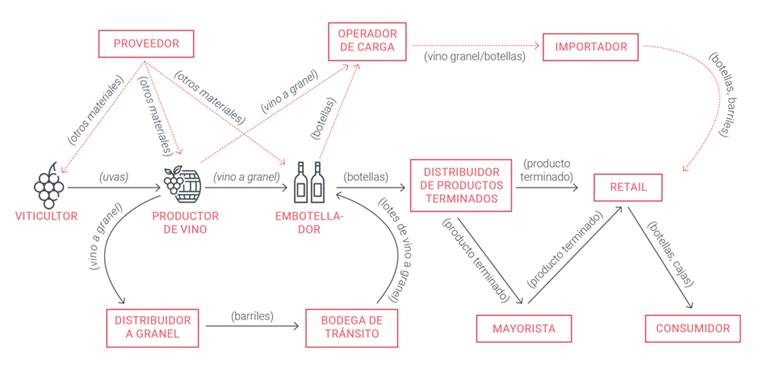
Source: Gasia, X. (2021), La tecnología blockchain aplicada a la trazabilidad de la cadena del vino, Addvante blog, 23.02. Note: Bottles, batches and labels have their digital identifiers (Dis), sent by DLT TXs to cargo operators or importers to trace cross-border transit. At a national scale, retail and final TXs on wine bottles and packages are fully traceable.
2.2. Tokenisation: primary and secondary transnational wine-market Development
2.2.1. DLT-industry concept of tokenisation as a digital representation of credit rights
Tokens or crypto-assets are transferable digital assets, and Tokenisation is the process of creation of a token in a DLT network (Ibáñez, 2021). Tokens must be created in a law-compliant manner, in order to a state acknowledgment of the represented rights. They translate into digital language (in the case of DLT, under blockchain or distributed-ledger decentralization premises) the characteristics and relevant data of the represented entity or reality. In the case of wine tokens, the represented object preexists before its derived token, which is (by contrast with native tokens like Bitcoin) a non-native token, encompassing inherent rights of property, ownership or possession, including posterior burdens in rem or subsequent rights. Non-native tokens like wine cryptos are born and have been originated in a legally valid contract, thus referring to the contents of the rights and correlative obligations tied to the celebration and fulfilment of such original contract, in a similar way that traditional paper-represented or electronic securities have been representing the contents of investment contracts to be traded in organized stock markets.
The practical exercising of some of such rights, like selling, and linked marketing and trading faculties (e. g. right to offer tokens in an ICO / ITO public offering, and rights to trade, pledge or swap them in secondary DeFi platforms) depends on the organization of DLT exchanges or marketplace, which in the case of DLT multilateral facilities must be implemented in accordance with the rules of a decentralized exchange (commonly known as decentralised finance exchange -DeFi DEX-, or a more centralised one -DeFi CEX-) coherently with DeFi market structures. On DeFi trading platforms or decentralized marketplaces, traded objects (tokens, virtual assets) have no financial purposes themselves, serving to a variety of subjective purposes or aims, from wine price speculations to wine final consumption or gourmet wine collection. Wine token markets are not necessarily investment markets, since the represented rights may correspond with faculties other than trading: ownership, possession, transit, exportation or consumption of the underlying product, which is a physical asset.
2.2.2. Characterization of wine tokens representing rights in rem
Wine tokens represent (but they do not “incorporate”, like old securities did in paper) credit rights against its issuer, who can be the offeror in an initial token offering (ITO) or a different person, ordinarily in narrow connection with wine industries (producer, winery or wine cooperative). Such connection motivates the offeror to create the tokens for mostly unknown investors (as in securities exchanges), who hold rights against the offering entity or legal person, as promised in the offering ITO document (usually known as ITO / ICO white paper).
Among the promised committed obligations, and apart from the credit rights acknowledged by the offeror, this one usually grants wine token holders rights in rem on the underlying wine, consisting on the faculties of possession, disposition, transportation, physical empowerment an technical availability on the lots, batches, packages or pallets containing the wine, or on related materials (labels, QRs, IoT devices…). Such rights can be only exerted under signed arrangement and contractual schemes, published or not in the ITO prospectus or whitepaper, and they are claimable against the issuer but also erga omnes, since existing private-law regimes protect the effective exercise of the granted in rem faculties. Note well that in rem rights belong to the token holder, and correspond with the faculties of a physical owner. Initially, the configuration of the rights of disposal can be made as a sort or variant of credit right exercisable against the wine cellar or depository company designed in the contract. Among the credit rights attached to the token it is to be outlined the right of compensation against the issuer in cases of token market failure or issuer insolvency.
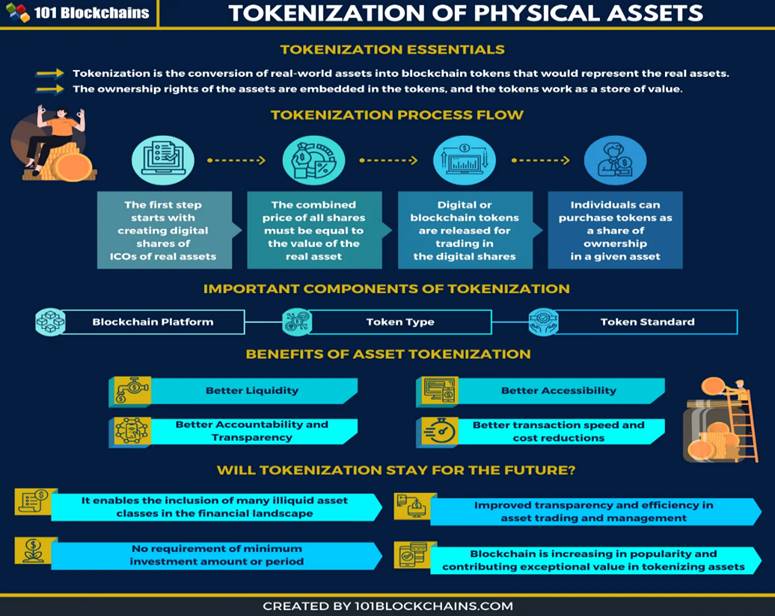
Irrespective of the obligations corresponding to token issuers, CEX market administrators and platform managers, in the case of DeFi platforms, need to set policies guaranteeing the correct and timely exercise rights of token holders. They must facilitate the connection between the token market and the underlying deposit or wine stock, providing contact with depositories where wine assets can be possessed and appropriated (eventually under an Asset Reference Token or ART reserve regime), ensuring their availability and eventually their direct delivery or alternative effective selling as pledged collateral. In all cases, ICO preset token price must equal the value or the real asset according with its market value before DeFi secondary trading and subsequent token DLT purchase by final investors at par value, ensuring liquidity, transparency and cost reduction as shown below.
Figure 2. Tokenisation of physical assets: process flow.
Source: Iredale, G. (2021).
2.2.3. Verified authentication of tokenised objects: new developments
Classic identification objects like QR codes, barcodes and labels are giving in to RFID technology for physical identification of wine. RFID devices do not need scanners to directly point at a tag, and can read multiple tags; hence shifting their demand in the wine and other bottling industries. RFID brings wine authentication and prevents the sales of counterfeit or fake wines. Many wineries are using this technology to make sure that only authentic wines reach the market. RFID tags on bottles or packages identify them, but also verify such identity, performing an act of authentication. Distributors, exporters or consumers easily tap the dispositive set in the bottle and verify the authenticity of the product (Danese, Mocellin & Romano, 2021)
More recent IoT solutions incorporate a variant of High-Frequency (HF) RFID tech, Near Field Communication (NFC) tags, useful in wine identification use cases. NFC secures wine-data exchanges, acting as an automated reader and as a tag, allowing for communicate peer-to-peer. Recent more complex NFC tags read smart tags, thanks to a read/write operation mode, involving two-way communications: card emulation and P2P (peer-to-peer). NFC is optimal to transmit and exchange wine bottle or item data, but not to locate and manage wine location, since it is not operative beyond the detectable magnetic field. However, a smartphone and a payments reader within checkout lines, or two smartphones, can exchange online data in a bi-directional communication context. For instance, between two terminals put together in order to exchange wine tokens for money or crypto-assets. Besides, NFC allows communication from “passive” tags, placing an NFC-enabled dispositive set in a bottle on a tap-to-pay credit card terminal; the energy coming from the NFC reader sends energy excites the NFC chip in the card.
This principle can be extended to SC oracles connected to a blockchain, thus permitting and authorizing the performance a TX to pay for the bottle. When a scanner verifies the oracle, this one (like a plastic card in smart NFC payments) ensures that the reader is valid, two-way processing the TX. Thus, NFC tech shares physical properties with RFID tech, and NFC tags enable bidirectional peer-to-peer (P2P) data sharing in a blockchain when executing wine-verification transactions, for industry authentication purposes, or for wine payment verification on sales transactions or token execution. Decentralised D-App interfaces operative in smartphones are starting to be available in wine token markets (WTM); bottles witn D-App connected NFC chips built in minimise market costs via NFC-based interoperable system, whenever business gains sufficient scalability combined with blockchain interoperability (Rogerson & Parry, 2020)
In this context, winemakers and wineries gain easier access to an NFC authentication technology with data encryption, a solution sufficiently essayed for great vintages which is being extended to standard productions (e.g., Burgundy’s Geantet-Pansiot, since 2015). Note well that the risk of undue appropriation or forging cannot be absolutely eliminated, but it is considerably reduced using NFC authentication devices, which use secure NFC tags authenticated by mobile apps. The users are winemakers, producers and also consumers, to whom wine quality and origin is substantially assured and guaranteed through confidence on the NFC platforms and connections. BaaS is used to record the data supplied on NFC platforms, in a tamper-resistant way, incorporating it onto a blockchain at minimal TX cost.
2.2.4. Token-based primary and secondary marketplaces: legal and economic foundations
Modern finance is based upon security marketplaces, in which security issuers can find anonymous funding for their projects. The Distributed-Ledger Technology or DLT, mainly in its blockchain version, facilitates the creation of easily and rapidly movable virtual assets called tokens, tradable in decentralised-finance (DeFi) platforms (Zetzsche, Arner & Buckley, 2020), playing the same role that stock exchanges use to play in classical stock or securities markets. In a DeFi context, tokens can be transferred in decentralised-platform exchanges (DEX) but also in more centralised platforms (CEX exchanges) supervised by competent authority.
Credits born from token issuance or ITO in primary markets should be enforceable in courts against the issuer of the token or person on behalf of which such issuer acts. It is crucial for each legislator to properly regulate the rights of token holders, but such regulation depends primarily on the nature of the token and the contents of rights incorporated therein. DLT tokens can validly represent in rem rights in favor of the token holder. Wine tokens, incorporated to a DLT network for unexpensive, fast and traceable transfer of rights, can represent wine bottles, batches or other vine and wine-related real or physical assets. Wine token markets (hereafter WTMs) may boost traditional physical wine markets, bringing benefits that can be synthesized as follows:
a) Virtual anticipated wine deliveries with full security and assurance of value.
b) Enhanced security by digital certification of provenance and merchandise authenticity, guaranteeing quality original characteristics.
c) Low-cost intermediation in international markets and elimination of unnecessary brokers or commission merchants and agents.
d) Suppression of transaction costs in the process of distribution and storage.
2.3. Wine-token market conditionings and forthcoming developments
2.3.1. DLT wine market recent essays
Recent WTM essay DLT TX deployed by smart contracts connected to ultralight chips (like MIFARE) enabling the winemakers and wineries a secured safeguard of their wine distribution networks, protecting their wines from counterfeiting, and combatting gray markets with efficacy, and directly communicate with their customers P2P and in a targeted manner. Segmented or selected customers can authenticate each bottle and verify information about the wine (origin, vintage, production, oenological characteristics, serving temperature, storage, optimal conservation…), just tapping back labels or analogous in-bottle devices with an NFC smartphone app. Such authenticated data can be distributed online by DLT TXs readable by any interested person accessing an authorised node in the case of PPDLs, which raise substantially the level of stakeholder protection in comparison with existing technologies. The prompt reconnection between winegrowers and customers boosts productivity and consumer satisfaction, enabling the detection of gray-market actors by bottle-tagging, thus making costly and inconvenient the activity of counterfeiters and brand imitators.
In most recent case uses, Blockchain-inherent combined publicity of NFC associated data serves to market security with extraordinary efficacy and fastness with respect to:
a) Bottle or batch sales promotion in wine markets stimulating competitive producers and promoting the enhancement of the distribution network, at pace with consumer rational decisions on wine acquisition and consumption at the lowest cost possible.
b) Uniform bottle or batch tracking, loading an app in an NFC-enabled smartphone. Each traced bottle can be assigned to a distributor, importer or final customer in a particular geographic area.
c) Vintner identification via online platforms acting as brand managers, by NFC installed in smartphones. Distributors and importers can be invited to identify themselves and scan the bottles to ensure proper delivery to their final destination, gaining relevant information on wines and estates. Such data can also be shared by consumers accessing a public blockchain, who may also scan bottles using a unique tag for each bottle with an encryption system, minimizing the risks of wine duplication; they identify an automated visual marking of the identified object as fake or original.
2.3.2. Risk mapping concerning wine-token markets
a) Legal risks and risks connected with wine market fraud.
Wine Tokenisation raises the problem of the legal consequences that should be tied to the non-maintenance (eventually in the context of breach of contract) of the due correspondence between the pacific and juridically valid possession of the asset, and the actual situation of such asset. At all stages of WTM commerce, laws must ensure that token holders’ rights are respected, and that cannot be ensured without enforcement of the consequences tied to an eventual divergence between the current status of wine and the status corresponding to the creation, possession and property of the representative digital asset or token.
Apart from legal risks connected with the token, laws should prevent risks born by token holders because of mala fide action of third parties or caused by force majeure (loss, damage, misappropriation, consumption, unauthorized traffic, unconsented use of token private keys…).
Mandatory laws, both public and private, must solve irregular legal situations affecting the investor or holder like token unauthorized selling or stealing, private-key misappropriation, or other incidences related with the property or ownership or rights exerted on the underlying physical asset. This is why market depositories and platform managers must guarantee the appropriation rights of the token holder or grant equivalent rights (Brookbanks &Parry, 2022).
Anyway, efficient regulation must encompass protective rules guaranteeing the correct exercise of rights in both on-chain and off-chain wine markets, attributing liability to platform managers, token intermediaries and wine depositories, for timely and continuous assurance of the legal status of both digital and represented assets. In the case of NFTs representing specific bottles, batches or lots of underlying wine (also specific grapes, or specified vines or vineyards), the token should not be reputed “commodity” since the essential characteristic of a commodity is fungibility, opposed to the non-fungibility defining NFTs as non-fungible assets (e. g., concrete numbered labelled fine-wine bottles).
b) Token market risks.
As in financial marketplaces, DeFi platforms suffer from trading risks that do not differ much from business and management ordinary risks:
(i) With respect to traded tokens, linked to the project of the issuer, like credit, price volatility, liquidity and organisational entrepreneurial risks.
(ii) Concerning the platform, risks associated with authorisation to operate like a trading market place, and those connected with financial experience and also with DLT and BaaS expertise of their founding teams and managers.
In the case of rising WTM industry, it should be paid attention to some specific market risks: market abuse (insider trading or market manipulation), depository trading (failure of misconduct of depositaries), international wine trading (unfair, delayed or non-compliant crossborder trades), and suboptimal token design, particularly in the case of NFTs using, within the context of Ethereum systems, the standard Request for Comments ERC 721 or ERC 1155 as alternative protocols idoneous for non-fungible or unique crypto-assets (for fungible tokens, the most common is ERC 20 as dominant protocol in DeFi marketplaces and permissioned blockchains or PPDLs since 2018).c) Cybersecurity and operational resilience risks. It should be noted the ERC3643 protocol, an open-source suite of smart contracts that enables the issuance, management, and transfer of permissioned tokens. Its built-in decentralized identity framework, ONCHAINID, ensures only users meeting pre-defined conditions can become token holders, even on permissionless blockchains.
Distributed PPDL TXs take place in associative models of auto-governing rules to facilitate the token and document trading in a trustless and efficient system. The DLT does not require (FG DLT D4.1 2019, DLT regulatory framework: 6) trusting a single entity or participant. In permissioned-ledger environments, Public Key Infrastructures (PKI) can produce signatures required to comply with regulatory requirements like "Know Your Customer" (KYC) or Anti-Money Laundering (AML) rules that are commonly applied to financial services organizations. In this context, PKI may be used both for digital signatures and for access control to a ledger platform with an authentication protocol such as Transport Layer Security (TLS). In the EU context the Digital Operative Resilience Act (Regulation (UE) 2022/2554 of 14 December 2022 on virtual resilience for the financial sector compels token service providers managing information and communication technology risks reporting major related incidents (e. g., token payment-related) and significant cyber threats to the competent authorities. Service providers and platform managers must also perform digital operational resilience testing, sharing Intelligence on cyber threats and vulnerabilities and measuring the sound management of DLT and other digital third-party risks derived from BaaS contracting or from the provision of services by professional providers as intermediaries, key custodians, market makers or exchange crypto depositaries.
3.1. Legal relevance of the token and tokenisation concept from a private-law perspective
Tokens use an algorithm implemented as a Smart Contract (SC), deployed on-chain, automated and self-executed on blockchain. Each SC contains an address list that allows finding the eventual token holders and their balance or amount possessed. Such technological structure can be linked to legal activity, and actually is. The same way that SCs can be “legal” when they are produced (issued) to celebrate contracts under valid legal conditions (consent, object and consideration), tokens have a “legal” structure and teleology if used to represent and contain rights, linking a legal object or consideration with a digital form of representation.
Therefore, tokenisation implies the creation of a digital form connected with a legitimate right or bunch or rights represented by the token, legally reputable as an asset. Thus, tokenisation in an economic and legal sense requires the previous celebration of one or more legal agreements, expressed in algorithms in the DLT process of token creation, and deployable within the SC DLT layer of the blockchain wherein tokens are born. To this extent, the “ligature" or liaison that links the digitally represented rights with their cryptographic form, entitles token holders to possess and transfer by virtual means the corresponding linked physical or digital “underlying” or tokenised asset, which can be considered as an out-of-the-blockchain or off-chain asset, living outside the distributed ledger. That is the case of financial (DeFi) tokens and also the case of tokens representing rights on physical assets, like wine.
Tokenisation is legally relevant since it results in the tradability of the crypto-assets in exchanges running on DLT (DeFi) platforms and in token transaction held on those platforms. The technical validity of the TXs on tokens is guaranteed in the tokenisation process (particularly in the case of PDL tokens, always non-DLT-native, contrarily to PoW permission-less network tokens like Bitcoin). The technological algorithmic definition of a token characterizes it technically, setting the boundaries of its functioning on chain, but also the perimeter of the token economic and legal boundaries. The system for token access by the token holders by means of wallets and keys is technically predetermined, serving to the end of demonstrating their ability, as token owners or proprietors entitled, to dispose of it, on the condition that they use the private key associated with the public key from which the address of the acquirer or subsequent holder is obtained.
Tokenisation and issuance of wine cryptographic assets entails key legal implications, including:
a) A prefiguration of credit and in rem rights attached to the token, according with an off-chain contract (ordinarily under initial coin or token offering -ICO / ITO- regulation) between token issuer / offeror and accepting buyers, explained in legal form in accordance with existing regulations on the ITO informative whitepaper or prospectus.
b) The need of designing a system for the proper exercise of such rights and fulfilment of the corresponding obligations, as the token holder is entitled to claim the contents of the represented rights against the issuer or linked third party.
c) The option for a valid and legally effective system of transmission of the rights ascribed to the token, in accordance with local jurisdiction rules applicable to the issuance or primary-market arrangement by which the rights of the token holder are born and can be exerted. DLT transmission implies using private keys to sign TXs recorded on the blockchain (on-chain) and accessible to the contracting parties operating in CEX or DEX in their digital wallets.
3.2. Key legal obstacles posed to the creation of a wine market
a) Data intermarket correspondence between token and physical market.
Such correspondence must be guaranteed in terms of data equivalence and verifiability, whatever system is use to identify the assets, digital or not. The identification of wine batches or bottles can be done in accordance with GS1 world-trade standards and principles. The aforesaid global standards define trade items (products or services priced, ordered or invoiced at any point in the supply chain) and global-trade identifiers (identification or identity numbers of the item, GTIN) for all tradable items like packages (consumer units, cases, pallets) or production batches identifiable by lot or batch numbers, expiry date and similar data. Each GTIN, which is fully compatible with the ISO/IEC 15459 standard (namely, Part 4, “Individual products and product packages”) identifies unambiguously each trading item before any trade partner worldwide, thus permitting an easy individuation and identification in trade or commercial documents of any kind like catalogues, purchase orders, invoices, web pages… to easily communicate data on the item. Such number can be encoded in a barcode or in an electronic product code and radio frequency identifier (EPC/RFID) tag, which is checkable in a store or controlled by competent operators when goods are delivered after transportation in different logistic or distribution stages.
b) Lack of legal acknowledgement of smart contracts and/or blockchains a as valid means to create or transfer rights.
This problem seems to be progressively overcome by new regulations like Market in Crypto-assets (MiCA) Regulation (v. infra, 3.3), applicable to wine tokens as far as they are to be considered asset-referenced tokens (ARTs), or even whey they are to be traded in a platform regulated in accordance with MiCA provisions where crypto-asset service providers (CASP) are authorised to provide token trading services.
c) Insufficient or inexistent regulation for virtual wallets serving the trading needs of purchasers, acting as automated stores and repositories. Token account and deposit investment auxiliary services should be provided with respect to deposited tokens, either with or without custody service provision (in the former case, by custodial wallets, in the latter using “non-custodial” wallets). Wallets must be available for wine token issuers to receive funds from accepting token buyers, ana also for buyers to make token payments. Wallets can be self-custodied by vineyard owners or winery producers, and such non-custodial wallets should be compatible with ERC20 SCs and can be assigned by platform manager or WTM administrator to clients for them to transact with WTs in self-custody; or be custodied by CASP specialized custodians, or platform managers, eventually connecting fiat or crypto-exchange or swap services. Wineries, cooperatives and winemakers or other WM actors accepting wine as means of payment can use specific “merchant wallets” containing ERC20 or similar fungible tokens, attracting more TX volume to the DeFi platforms. The platform management, the custody contract and TX orders given by token purchasers must be regulated, and this is what is starting to be done in the EU with 2023 MiCA regime, although the framing of wine tokens to be embedded in MiCA categories is difficult, as we explain hereafter (in 3.).
3.3. Reference to EU MiCA regulation considering wine tokens as non-ARTs
Within the context of the 2023 definitive version of the EU Regulation on Market in Crypto-assets (MiCA), amending the 2020 Proposal of 24 of September, asset-reference tokens (ARTs) are stablecoins referred that purport to “maintain a stable value by referencing another value or right or a combination thereof, including one or more official currencies”. Thus, the referred asset can only be fiat or official money issued by a central bank as official currency, expressly excluding (as in art. 3 of the 2020 Proposal) the possibility of construction of ARTs based upon “one or several commodities” or a combination of these ones with “one or several crypto-assets” or with legal tender.
This suppression solves many practical problems associated to the constitution, supervision, composition, investment and governance of the “reserve assets” (art. 3.21 in the Proposal, suppressed in the 2023 text where “commodities” disappear as a possible kind or category) that the ART issuer must set to protect the token value and the effective exercise of rights granted to the token holder, particularly in the case of anticipated redemption of the tokens (e. g. in case of winding-up or declared insolvency of the token issuer). The need to coordinate financial intermediaries like CASPs with non-financial intermediaries for the exercise of rights (like depositaries of physical wine) was a subject put aside of consideration in the 2020 MiCA proposal, and the 2023 confirms such dismissal. Wine cannot be any more a part of the “reserve of assets” (article 3, definition 21) or “basket of reserve assets securing the claim against the issuer” of wine tokens.
Thus, wine cannot back the value of wine tokens considered as ARTs, since such tokens cannot be regulated as ARTs or stablecoins in accordance with MiCA provisions, without any doubt due to the hesitation of the legislator in considering wine commodity markets (and commodity markets in general) as sufficient reference to stabilise the token, even though agricultural prices were regularly published in official secondary exchanges.
This does not impede the consideration of wine tokens as non-stable coins within the scope of MiCA regulation, when ITO is addressed to the public and whitepaper and publicity regime is applicable, and tokens are envisaged for CEX or DeFi trading in secondary platforms, to be “transferred and stored electronically using DLT or similar technology” (art. 3.2 MiCA).
4.1. Digitisation and economic vineyard and vine exploitation models
4.1.1. IoT, AI, virtual reality (VR) and other complementary technologies on vineyard and vine exploitation
An effective combination of PPDL blockchain TXs deployed by SCs connected to IoT sensors helps monitoring the vineyards, while PDL TXs documenting the data collected for relevant parameters of the vineyard (moisture, temperature, light, surfaces…) can improve sustainability of vineyards. Also in wineries, the incorporation of machine-learning AI / VR algorithms, together with tiered scalable production- and stock-predictive models, enables managers, owners and partners in cooperatives, wine-distribution centers and logistic organizers, to adopt insightful prompt decisions on key business areas for wine entrepreneurs like sales planning, storage, wine market segmentation, varietal choices and temporal adjustments in blending, or transnational distribution of bottles to export. The reason behind such optimization of decisions is, in a DLT context, the blockchain traceability, which also facilitates immediate shared information across all steps of wine production, and at once empowers DO auditors and wine-market public authorities to enhance the conduction of their audits and the execution of their supervisory competences (Geroni, 2021)[6]. Moreover, NFC systems combining dual-mode smartphone applications and IoT devices connected to PPDL nodes or terminal by proper inter-faces are starting to be available in CEX and emerging DLT smart-wine interoperable platforms.
IoT/AI apps collect, monitor and analyse wine-production big data handling analytical algorithmic solutions (assuming standard ontology and semantics) which can be deployed in DLT TXs for optimal management and exploitation. Analytical dashboards support new decision models on wine production and distribution in accordance with automated analysis of results by IoT platforms that previously monitor vine harvest and related KPIs, the whole grape fermentation process and the bottling process, even predicting the impact of weather conditions on the harvest to reckon optimal wine-stock maintenance models, according to structured analysis of manufacturing data (pH, alcohol volume, potassium…) thus prevent wine-quality ad hoc risks and potential cost increases.
4.1.2. The impact of blockchain as a transversal tool for the integration of ICT experiences to gain traceability and explore new digitalised markets for sustainable vine and wine exploitation models throughout the chain of value
Two main impacts of DLT can be found for sustainable exploitation of wine and vine under interprofessional cooperative models: vineyard and winery big data and legal-compliant documentation sharing, on one hand; on the other hand, wine global secure trading by means of crypto-assets traded in DeFi DLT exchanges (Luzzani, Grandis, et. al., 2021)
Both industrial utilities require some degree of centralisation, despite the inherent advantages of anonymity brought by node decentralisation and delocalised distribution. In the case of DLT / IoT-AI data collection and distribution, some data re-centralisation facilitates the legal-compliant and transparent access to distributed data; in the case of wine tokens, CEX re-centralisation foments a proper access of competent spot and forward token market supervisors and related agricultural administrative competent authorities for the legal, orderly and transparent trading of tokens, in order to protect market integrity and invested value, bringing certainty and confident to new DeFi commodity agricultural markets and to wine physical trading itself.
4.2. ICT-based wine market experiences
Since 2020, digitally pioneering wineries have used drones in vineyards to map maturity, vigor and quality of the grapes, setting the optimal time for harvesting. The Polytechnic Unit of Valencia (Spain) presented an autonomous vineyard-monitoring robot as part of the Vinescout project. This model that assists wine producers in measuring key vineyard parameters such as vine water status, leaf/canopy temperature and plant vigor. Robots combine 3D vision with ultrasound sensors and AI for precise plant driving.
AI-driven robots can monitor grape yield, vegetative growth and grape composition data, mapping crop quality in specific zones and preventing disease or controlling excess growth, recommending pruning or pesticide use. To perform these tasks, 3D images of the vine must be computed, allowing machines to move along, pruning and fertilizing. Several task of harvesting grapes can be also carried out by robotics, by shaking the vines and collecting the grapes as they fall from the vine, classified by IoT devices according to their place in the value chain. The agri-food value chain is an ideal place to demonstrate the usefulness of blockchain technologies (Navarro, 2022) with undoubted value in terms of transparency, traceability and security (Alzate y Giraldo, 2023).
Other European wineries implement transport management systems to control and optimise logistic flows, including artificial vision and robotics solutions to control the incoming flows and movements in the plant of raw material and finished product transporters.
4.3. Economic models for wine token trading
4.3.1. ART / wine market-value parity vs non-parity (non-stablecoin) models
Unlike electronic-money tokens (EMTs) and asset-referenced crypto-assets (ARTs) regulated in MiCA as stable-coins, requiring financial collateral to preserve the rights of token holders on the referred asset, ART wine tokens would not require financial collateral, but wine, grape or physical reserve to cover the value of tokens. This kind of reserve, under a market-value parity model, can be designed by cooperating interprofessional wine-related social actors, as an in-kind guarantee for token buyers, functioning as crypto collateral with several (but not severe) handicaps compared to fiat or financial collateral, like these ones:
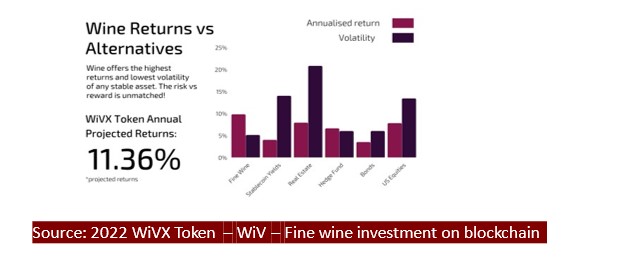
i) The collateral (wine, grape) price is not 100% price-stable in price, hindering or impeding the application of a stablecoin or parity value-assessment model; however, currency volatility could duplicate that of commodity markets, thus diluting the argument against wine or grape as non-stable parameter deserving to support the tokens, as shown below.
Figure 3. Comparison of wine-market volatility with investment alternatives.
Source: https://wiv.io/.
ii) It requires off-chain security specific on-site (winery, cooperative, depository stores) specific procedures to implement efficient mechanisms to protect the value of the stored assets, and parallel legal preventive measures in legal arrangement with depositories, together with appropriate management policies, to preserve the rights of holders in case of insolvency of the token issuer or in other cases wherein the reimbursement or redemption rights granted in the wine ITO are to be exerted.
iii) Reserve liquidation can be expensive and deferred. The aforesaid arrangements made in a context of social cooperation among WT issuers (namely vine producers and wineries) and intermediaries (namely wine cellars, central warehouses or deposits other from those owned or controlled by the issuer in order to avoid conflicts of interest) should set a range of wine managing measures to prevent unnecessary delays when lots, batches, bottles or wine in containers must be delivered to comply with redemption-right execution.
iv) Permanent asset audit is required to ensure WTM transparency and effectiveness of the policies and procedures implemented by token issuers with respect to holders’ rights set in ITO clauses, and also with respect to contracts with professional intermediaries and service providers in cooperative hubs and industry ecosystems around wine depos-it, custody, physical conservation and delivery when required by owners, token holders or entitled cooperative-industry enterprises.
Thus, significant comparative advantages of a deliverable commodity can be found in wine, not only as a transformed product fermented in cask or barrel, or kept in bottle, but also in form of fresh wine, wort, grape juice or must. Such advantages with respect to fiat as collateral can be synthesized as follows, resulting in a bunch of wine-market specific characteristics:
a) The availability of wine or must as real assets in a safe and more decentralized way, since no central bank or financial institution is necessarily required to manage the reserve and its maintenance, storage and investment. These functions are assumed by the specialized wine and vine industry entrepreneurs and the social wine-cooperative and wine-ecosystem related institutions (like interprofessional associations) with potential and actual specific interest in wine-tokenisation development.
b) The constitution of rights in rem (wine) or equivalent market-valued assessed compensation granted to the holder in case of wine-market failure. To this extent, financial institutions might be eligible for the coverage of the corresponding rights of damage compensation of WT holders, directly or subrogating in the position of covering banks against eventually defaulting non-compliant or contract-breaching wine-industries.
c) Higher decentralization of the underlying and consequent central-counterparty default-risk downsizing, whenever wine local social agents (namely wine-cellar managing depositaries) can guarantee enough reserve-value and properly audit the wine stocks or inventories; it is to be noted that wine is one of the few commodities that improve in flavor and value with age, but it can also rapidly deteriorate when kept in inadequate conditions.
d) Full collateralization, backing or guarantee of tokens with real assets deliverable in real wine markets, providing high liquidity at pace with market-value stability, independent from financial-market fluctuations. Let us not forget that physical assets always keep their intrinsic consumption value, irrespective of financial-asset volatility, without prejudice to the communication of market fluctuations among all markets. Specific financial market and price risk are out of the scope of WTMs.
Adopting either a parity or a non-parity assessment model, the governance of WTs includes among other key functions to preserve token holder’s rights:
i. The legal establishment and official approval of the market in one or more competent jurisdictions. At EU level, in accordance with MiCA Regulation provisions in the case of non-MiFID2 specific crypto-asset DeFi-platform CEX-based trading.
ii. The definition of the governance perimeter functions, including the DLT framework and protocols for effective and efficient token and underlying-wine trades.
iii. The appointment and cessation of token platform governors or administrators and managers in both PPDL CEX and underlying related market or contracting wine marketplaces or trading facilities. EU-traded wine tokens could be regulated either under MiFID 2 securities law provisions, when tokens were qualified as “securities” or “financial instruments” ex art. 4.15 MiFID 2 Directive of 2015, or in DeFi exchanges, avoiding the applicability or regular stock-exchange ruling -e.g., on settlement of positions under central depositories’ EU rules-. But such option is unlikely to be chosen by CEX platforms since wine underlying markets do not use to be quoted commodity markets, thus reducing the probability of official MiFID regular trading. Most wine tokens would fall even out of MiCA provisions in cases wherein token issuer is not obliged to provide ITO / ICO public (whitepaper) transparency.
iv. The channels and operative structures required to start token circulation, suspend or block the trades and terminate the trades in cases of DLT layer failure, SC bugs, network interruption, node difficulties or lack of operation of the platform by any reason.
v. Voting rules and rotation rules in node operations, revocation rules applicable to managers, and eventual modification of token protocols.
vi. Contract-law relevant definitions of tokens, wine tokenisation, exchange of token for physical, transaction or circulation specific rules, market inner regime on auxiliary market contracts and on economic parameters relevant for contracting (namely, on token deposit, wallet and token-key administration, brokerage and dealing, and exchange fees amongst other. Market incentive fees for the different crypto-assets generated are also a key item for the legal and economic proper implementation of the DeFi platform.
vii. Societal and company-law related rules on platform or exchange company dividend distribution, and other relevant company-law rules concerning agreements on majorities, rights of preference, separation and exclusion of tokens from the platform.
viii. Market general conditions and according regulation of prices, namely on the relationship, measurement, limits and publicity of the spot and forward wine or grape prices in the relevant segments of markets, and their correlation with crypto prices, particularly in the case of configuration of tokens as ARTs conferring rights on wine reserve assets.
4.3.2. Futures trading and other derivative exchanges for wine tokens
Forward DeFi wine trading entails among other requisites that intermediaries of wine tokens or wine crypto-asset service providers (CASPs under MiCA provisions) are qualified as “investment” service providers in the sense of MiFID and MIFIR regulations; the consideration of the corresponding forward token markets as impersonal contracting facilities with public official trading exchanges operative in regular sessions would require specific norms for the standardization of precontractual futures and options trading on underlying wine or wine cryptos, in particular with respect to brokerage and broker or dealer intervention, including market specific MiFID rules of conduct to prevent market abuse an protect market integrity; and post-contractual schemes of setting off and liquidation of trades in accordance with central depositaries of securities and multi-tier registration of TX by such central entities, opposite to DEX (and even CEX) decentralized DeFi philosophy. Anyway, the characteristics of DeFi auxiliary BaaS service providers and CASPs like private-key suppliers or specific automated market makers (AMMs) could fit derivative MiFID-rule contracting. Another option for futures trading is the application of MiCA regime for the efficient secondary-market forward wine tokens governed by CEX specific rules, considering the double peculiarity of the tokens as tradable assets with a mixed finality, consumption of the underling wine and possible speculative forward investment or hedging of spot wine positions, liquidated according to detailed requirements to execute contracts with vineyard or wine DO regulatory specifications on traded bottles, batches or lots to be delivered, in the case of physical delivery of assets as foreseen in forward or option contracts.
Combined ICTs and permissioned DLTs transform vine and wine exploitation models throughout the chain of value. An eco-sustainable collaborative wine economy is arisin from the digitalisation of the vine and wine economy, combining ICTs with PPDL TXs.
Automated digitalised tools like drones and robots can deploy their data onchain. In the final stages of the value chain, the use of robots, AI and Iot is already common in many warehouses, and, for some logistics centres (e. g., inventory control points), it is necessary to efficiently track inventories in different locations, helping to increase the productivity of the distribution stage. Through smart wine and grape AI-robotic storing, DLT can help new wine marketing via smart shopping, efficiently ending the wine life cycle.
As DLT-enhance distribution and commercialisation are more efficient due to time savings in data collection and document distribution, downplaying the cost of operational tasks, wine-chain logistics flows substantially improve efficiency. Token markets also feed and boost wine market efficient, allowing consumers to improve rational consumption and investment decisions.
The authors declare that they have no conflict of interest in relation to the subject matter of this work.
In accordance with the CRediT criteria (CRediT – Contributor Roles Taxonomy (niso.org)) as set out in the journal's authorship policy (Authorship Policy | REVESCO. Revista de Estudios Cooperativos (ucm.es)), both authors declare that they have contributed to the drafting of the article, with Professor Javier W. Ibáñez mainly contributing to the conceptualization and initial writing of the document, and Professor Ricardo Palomo to the inclusion of supplements and review of the writing.
Adamashvili, N.; State, R.; Tricase, C.; Fiore, M. (2021). Blockchain-based wine supply chain for the industry advancement. Sustainability, 13(23), 13070.
Alzate, P.; Giraldo, D. (2023). Tendencias de investigación del blockchain en la cadena de suministro: transparencia, trazabilidad y seguridad. Revista Universidad y Empresa, 25 (44), 1-29.
Awan, S. H.; Ahmed, S.; Safwan, N.; Najam, Z.; Hashim, M. Z.; Safdar, T. (2019). Role of internet of things (IoT) with blockchain technology for the development of smart farming. Journal of Mechanics of Continua and Mathematical Sciences, 14(5), 170-188.
Borrero, J. D. (2019). Sistema de trazabilidad de la cadena de suministro agroalimentario para cooperativas de frutas y hortalizas basado en la tecnología Blockchain. CIRIEC-España, Revista de Economía Pública, Social y Cooperativa, (95), 71-94.
Brookbanks, M.; Parry, G. (2022). The impact of a blockchain platform on trust in established relationships: a case study of wine supply chains. Supply Chain Management: An International Journal, 27(7), 128-146.
Danese, P.; Mocellin, R.; Romano, P. (2021). Designing blockchain systems to prevent counterfeiting in wine supply chains: a multiple-case study. International Journal of Operations & Production Management, 41(13), 1-33.
Galati, A.; Vrontis, D.; Giorlando, B.; Giacomarra, M.; Crescimanno, M. (2021). Exploring the common blockchain adoption enablers: the case of three Italian wineries. International Journal of Wine Business Research, 33(4), 578-596.
Gasia, X. (2021). La tecnología blockchain aplicada a la trazabilidad de la cadena del vino, Addvante blog, 23 February.
Geroni, D. (2021). A comprehensive guide on blockchain traceability, 101 Blockchains, Guides, 7th September, https://101blockchains.com/blockchain-traceability/.
Ibáñez Jiménez, J.W. (2021): Tokens valor (security tokens), Régimen de los Criptoactivos negociables y sus mercados (MICAS). Reus (Madrid, España).
International Organisation of Vine and Wine (OIV) (2023). https://www.oiv.int/index.php/what-we-do/standards 30th. July, 2023.
Iredale, G. (2021). How Tokenisation of physical assets enables the economy of everything?, 101 Blockchains, 5th March.
Luzzani, G.; Grandis, E.; Frey, M.; Capri, E. (2021). Blockchain technology in wine chain for collecting and addressing sustainable performance: An exploratory study. Sustainability, 13(22), 12898.
Moreno, M. V. F.; Garcia-Pardo, I. P. (2009). Estrategia de innovación como factor determinante del éxito de las cooperativas vitivinícolas de Castilla la Mancha. REVESCO. Revista de Estudios Cooperativos, Nº 98, pp. 70-96.
Navarro Lérida, M. S. (2022). Cadena agroalimentaria y relaciones de red: sostenibilidad y generación de valor a través de las tecnologías de registro distribuido (blockchain), Derecho de Sociedades, Concursal y de los Mercados Financieros (libro homenaje al profesor Adolfo Sequeira Martín), 2022, pp. 887-907.
Palomo, R.J. & Isabel, C. (2022). ¿Cómo puede incidir en la Economía Social el vector de digitalización de los fondos de recuperación?, CIRIEC-España, Revista de Economía Pública, Social y Cooperativa, 104, 143-172. DOI: 10.7203/CIRIEC-E.104.21497.
Rogerson, M.; Parry, G. C. (2020). Blockchain: case studies in food supply chain visibility. Supply Chain Management: An International Journal, 25(5), 601-614.
Salla, Y. M.; Fransi, E. C.; Adillón, M. J. G. (2013). La implementación de las TIC en la gestión de las cooperativas agroalimentarias: el caso de la provincia de Lleida. REVESCO. Revista de Estudios Cooperativos, Nº 110, pp. 223-253.2
Sarria-Pedroza, J., & Fernández-Guadaño, J. (2021). Evaluación del impacto de políticas públicas: análisis temporal del programa de reindustrialización en España. CIRIEC-Espana. Revista de Economía Pública, Social y Cooperativa, (102), 291-328.
Unurlu, Ç. (2021). The integration of the blockchain technology into wine tourism. In Blockchain technology and applications for digital marketing (pp. 186-209). IGI Global.
Zetzsche, D.; Arner, D.W.; Buckley, R.P. (2020). Decentralized Finance. Journal of Financial Regulation, 6(2), 172-203.
Ziolkowski, R.; Miscione, G.; Schwabe, G. (2020). Decision problems in blockchain governance: Old wine in new bottles or walking in someone else’s shoes? Journal of Management Information Systems, 37(2), 316-348.
[1] Cf. EUROPEAN ECONOMIC AND SOCIAL COMMITTEE –EECS- (2007), Opinion of the European Economic and Social Committee on the ‘Proposal for a Council Regulation on the common organisation of the market in wine and amending certain Regulations’ COM (2007) 372 final, 2007/0138 (CNS) (2008/C 120/10), https://eur-lex.europa.eu/LexUriServ/LexUriServ.do?uri=OJ:C:2008:120:0042:0046:EN:PDF, sub 1. (Summary of conclusions and recommendations), 1.3; EU COMMISSION (2006), Communication to the Council and the European Parliament — Towards a sustainable European wine sector, 14th Dec. {SEC (2006) 770 SEC (2006) 780} COM (2006) 0319 final, OJ C 325, 30.12.2006, p. 29, https://eur-lex.europa.eu/legal-content/EN/TXT/?uri=CELEX%3A520 06DC0319.
[2] Sustainable Global Goals (SDGs), adopted by the United Nations in 2015, call to global action against poverty and environmental deter, to foment prosperity by 2030. SGDs 1 to 3 are directly involved in wine-sector digitalisation: no poverty, zero hunger and good health; other SGDs are also concerned, like 7 (clean energy), 8 (economic growth, 9 (industry innovation) and 13 (climate action) or 15 (life on land).
https://www.undp.org/sustainable-development-goals?utm_source=EN&utm_medium=GSR&utm con tent=US_UNDP_PaidSearch_Brand_English&utm_campaign=CENTRAL&c_src=CENTRAL&c_src2=GSR&gclid=Cj0KCQjw1tGUBhDXARIsAIJx01mq4dfdYAJFKOtB74feWm7MON-J1vOpBOrHzvem5B5S5gapAw6KCC 8aAgWpEALw_wcB. SGD 12 (responsible consumption and production) is particularly concerned by the use of digital technology in vine and wine, together with more generic political SGDs 16 (peace, justice and strong institutions) and 17 (partnership for the goals).
[3] As Pau Roca -director general of OIV, who recently passed away- outlined during the closing words of the OIV Symposium “Digitalisation, the future of the vine and wine sector” (25th November of 2021, Delgrosso –Dir.-, https://www.oiv.int/en/oiv-life/digitalisation-the-future-of-the-vine-and-wine-sector), wherein we had the opportunity to discuss on legal and governance aspects of the digital wine-sector transformation in the round table “Challenges and Opportunities of Digital Transformation in the vine and wine sector”.
[4] As clearly formulated by the EUROPEAN COMMISSION (2022) Building trust in human-centric AI, https://ec.europa.eu/futurium/en/ai-alliance-consultation.1.html; ÍD., (2019) Ethics Guidelines for Trustworthy Artificial Intelligence, High-Level Experts Group on AI, Brussels, 8th April, esp. 12-14. Transparency is conceived therein as “explicability”.
[5] Agreeing, Geroni, D. (2021) A comprehensive guide on blockchain traceability, 101 Blockchains, Guides, 7th September, https://101blockchains.com/blockchain-traceability/.
[6] Agreeing, Geroni, D. (2021) A comprehensive guide on blockchain traceability, 101 Blockchains, Guides, 7th September, https://101blockchains.com/blockchain-traceability/.