 ISSN: 1885-8031
https://dx.doi.org/10.5209/REVE.92554
¿Es Airbnb una comunidad entre iguales? La profesionalización de las plataformas de economía colaborativa en España
Jon Morandeira-Arca[1] , Imanol Mozo Carollo[2], Julen Izagirre-Olaizola[3] y Aitziber Etxezarreta-Etxarri[4]
Recibido: 29 de julio de 2022 / Aceptado: 3 de noviembre de 2023 / Publicado: 11 de diciembre de 2023
Resumen. La aparición hace poco más de 10 años de diversas plataformas que permitían la gestión de alojamientos entre particulares supuso una revolución en el sector turístico. Los alojamientos turísticos han sufrido profundas transformaciones que han venido para quedarse. En los últimos años han surgido plataformas como Airbnb que han transformado la forma de gestionar alojamientos alternativos entre particulares. En un principio, estas plataformas se consideraban un ejemplo de la "economía colaborativa" que sitúan la dimensión social en una posición central en la economía. Sin embargo, en los últimos años, cada vez más agencias profesionales de gestión inmobiliaria también han comenzado a anunciar sus propiedades en la plataforma, poniendo así en cuestión el ideal original de consumo colaborativo entre iguales, así como noción complementaria al concepto de economía social.
En este estudio analizamos el nivel de profesionalización de la oferta de Airbnb en 10 ciudades y regiones españolas, con el objetivo de ver si se cumplen o no los principios de la economía colaborativa. En particular, estudiamos cómo se estructura el sector que, en Airbnb, varía entre agentes profesionalizados con múltiples anuncios y propietarios privados de un único anuncio. Además, tenemos como objetivo medir si el efecto de la pandemia del COVID-19 ha afectado a esta estructura, si ha generado respuestas diferentes entre los agentes altamente profesionalizados o entre los propietarios privados de un único anuncio en Airbnb. Este trabajo también presenta un estudio en profundidad del caso de Madrid en el periodo 2016-2020.
Palabras clave: Economía colaborativa; Economía social; Airbnb; Profesionalización; Estudios urbanos.
Claves Econlit: B55; D16; O18.
[en] Is Airbnb a peer-to-peer community? The professionalization of collaborative economy platforms in Spain
Abstract. The emergence a little over 10 years ago of various platforms that allowed short-term rental accommodation to be offered between individuals was a revolution in the tourism sector. The profound transformation that tourist accommodation has undergone has now become normalized. Over recent years, short-term rental platforms such as Airbnb have emerged and changed the way alternative accommodations are offered between individuals. Originally, these platforms were considered an example of the “Sharing Economy” that put the social dimension at the centre of the movement. However, more recently, professional property management agencies have also begun listing their properties on the platform, thereby bringing the original collaborative consumption ideal, and the complementary idea of being part of the social economy, into question.
In this study, we analyze the level of professionalization of the Airbnb listing in 10 Spanish cities and regions to assess whether or not the principles of the sharing economy are being met. In particular, we study how the sector is structured, which, on the Airbnb platform, varies between professionalized agents with multiple listings and private owners with a single listing. In addition, we aim to measure how the effect of the COVID-19 pandemic affected this structure, whether it generated different responses from highly professionalized agents compared to private owners with just a single advertisement on Airbnb. This paper also presents an in-depth case study of Madrid within the period 2015-2020.
Keywords: Sharing economy; Social economy; Airbnb; Professionalization; Urban studies.
Summary. 1. Introduction. 2. Airbnb and the principles of the sharing economy. 3. Estimating the professionalization level in Spanish cities and regions. 4. Discussion. 5. Conclusions. 6. References.
How to cite. Morandeira-Arca, J.; Mozo Carollo, I.; Izagirre-Olaizola, J. & Etxezarreta-Etxarri, A. (2023). Is Airbnb a peer-to-peer community? The professionalization of collaborative economy platforms in Spain. REVESCO. Revista de Estudios Cooperativos, 1(145), e92554. https://dx.doi.org/10.5209/reve.92554.
In March 2011, Bryan Walsh offered a wise piece of advice in Time magazine: "Today's Smart Choice: Don't Own, Share". The Airbnb platform was still in its very early stages, and the concept of the sharing economy was being more openly embraced: “But the real benefit of collaborative consumption turns out to be social. In an era when families are scattered and we may not know the people down the street, sharing things — even with strangers we've just met online — allows us to make meaningful connections” (Walsh, 2011: 1). In those early years trust had already been established as the driving force behind the collaborative economy (Cañigueral, Ortiz and Léonard, 2012; Ingram, 2012).
The sharing economy is an ensemble of online markets between peers that facilitate contact between seekers and suppliers of different goods and services (Barron, Kung and Proserpio, 2018), aided by recent developments in information technology (Wachsmuth and Weisler, 2018).The collaborative economy is a paradigm that constitutes a new approach to understanding the systemic transformation based on the digital revolution and the role of the social economy in this transformation (Chaves and Monzón, 2018). Airbnb, although a privately owned company and as such clearly not a social economy platform, could be considered as embracing the concept of the social economy through the functions it performs and the actors involved.
Suppliers to these markets are normally private individuals who decide to share excess capacity of a good or service that would otherwise be unused (Gil and Sequera, 2018). In this way, economic efficiency is improved and, judging by the exponential growth of this kind of platform over the past years, it seems to prove the existence of an underlying need (Barron et al., 2018).
Tourism is one of the sectors where the sharing economy is having its greatest effect, since in almost every element that makes up its chain of value (lodging, leisure, food, transport, etc.), there are practices which prompt a rethink of the current understanding of the sector (Moreno-Izquierdo, Ramón and Such, 2016). Within this context, software platforms for the exchange of short-term rental accommodation for tourists between private individuals are very popular, and Airbnb is one of the first, and now most popular, online platforms. In fact, Martin (2016) points out that the sharing economy has gained in popularity in the wake of the huge success of Airbnb and Uber. The success of Airbnb has prompted a large number of academic papers from different territories and cities around the world looking at its effect on the tourism sector and other territory factors, for example, in America (e.g., Barron, Kung and Proserpio, 2021; Horn and Merante, 2017; Lee, 2016; Lerena and Rodriguez, 2023; Sarkar, Koohikamali and Pick, 2020); Europe (e.g., Ayouba et al., 2020; Dabija et al., 2022; Garcia-Lopez et al., 2021; Gutierrez, Garcia-Palomares, Romanillos and Salas-Olmedo, 2017; Mozo et al., 2023; Rodriguez-Perez de Arenaza, Hierro and Patiño, 2022; Todd, Musah and Cheshire, 2021; Tong and Gunter, 2022); Asia (e.g., Tamilmani et al., 2022; Tran and Filimonau, 2020; Tseng and Chan, 2021); Oceania (e.g., Campbell et al., 2019; Gurram, Zhang and Shrestha, 2021; Von der Heidt et al., 2020); Africa (e.g., Mhlanga, 2019; Visser, Erasmus and Miller et al., 2017), or studies incorporating different continents (e.g., Adamiak, 2022; Sengupta, 2021). However, the idea of a sharing economy when referring to platforms such as Airbnb has been brought into question (Acquier, Daudigeos and Pinkse, 2017; Belk, 2014; De Vaujany, Leclercq-Vandelannoitte and Holt, 2019; Gil and Sequera, 2020; Schor, 2016).
Tourism is a sector that is extremely sensitive to economic events and unexpected occurrences. Airbnb was clearly going to be affected by a global pandemic, but we ask whether it has affected the different types of accommodation available on the platform in the same way or, to the contrary, has it led to a change in its profile. The 21st century has already experienced four pandemics (SARS in 2002, Bird flu in 2009, MERS in 2012 and Ebola in 2014-2016), but none had such significant implications for the global economy as the COVID-19 pandemic (Gössling, Scott and Hall, 2020).
The World Health Organization classified COVID-19 as a global pandemic in March 2020 (WHO, 2020). Many governments concluded that social isolation was a way of containing the spread of the disease, based on the premise that isolation would help prevent the collapse of the health system and guarantee that medical and hospital care was available for the most critically ill cases (Walensky and Del Río, 2020).
Tourism has suffered several crises in the past which have affected its development in the short and long term (Zeng, Carte and De Lacy, 2005). COVID-19 affected many tourism service providers, including Airbnb. It remains to be seen whether the negative impact on tourism will have long-term economic and/or structural consequences.
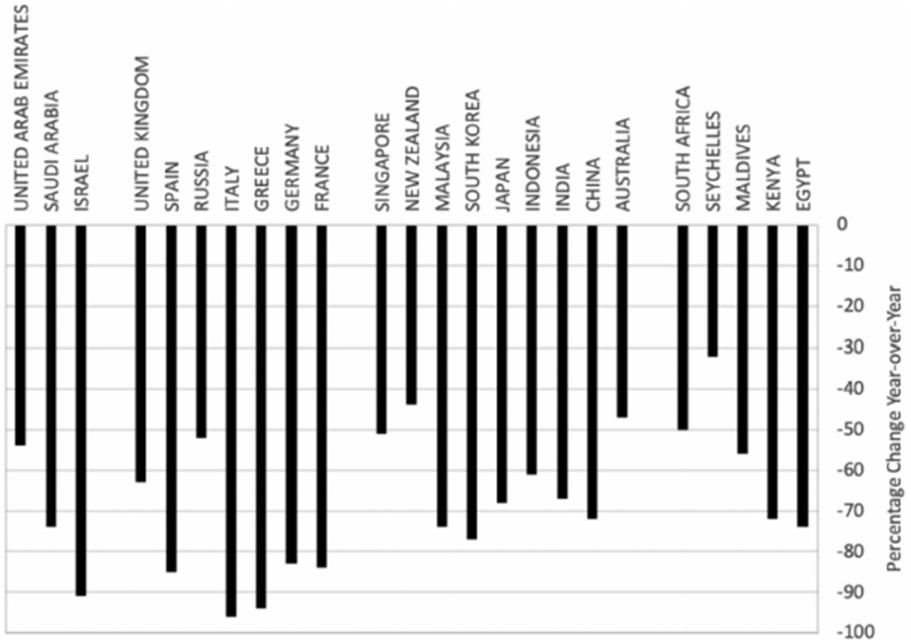
The impact of the pandemic on the accommodation sector is illustrated in Graph 1 for the week commencing 21 March and compared to the same week in 2019. In all countries, guest numbers declined significantly, by 50% or more (Gössling et al., 2020). The countries most affected were those most exposed to the global health crisis, with a greater number of infections. Spain was one such country.
Graph1. Accommodation occupancy rate change for the week of 21 March (year-on-year).
Source: Gössling et al. (2020, p.11)
In this study, we analyze the degree of professionalization of the Airbnb platform in 10 Spanish cities and regions at two critical points in 2020: pre-COVID-19 and post-COVID-19. In addition, an in-depth study of Madrid is carried out for the whole period 2015-2020.
This study makes three key contributions. Firstly, it analyses the structure of Airbnb in 10 of Spain's main tourist destinations (Madrid for a longer period, 2015-2020; and a further nine tourist destinations in 2020). The findings serve to question Airbnb's commitment to the concept of the sharing economy. Secondly, this research carries out an analysis that takes into account the COVID-19 pandemic, a circumstantial event that had dramatic and immediate consequences on the tourism sector. The study links the aforementioned effect to the degree of professionalization of the Airbnb offer. Thirdly, a relevant contribution is made from a methodological perspective. This study updates and completes an analysis recently carried out by Gil and Sequera (2020) on the professionalization of Airbnb in Madrid. In addition to extending the object of study to other Spanish tourist destinations, we aim to refine the methodology used in the analysis by examining the behavior of four indicators: (1) the percentage of hosts with multi-listings; (2) the percentage of entire apartments; (3) the percentage of intensive-use listings; and (4) the percentage of unavailable listings. This methodological improvement is further explained in the Methodology Section.
2. Airbnb and the principles of the sharing economy
The concept of the sharing economy has been analyzed from a very broad perspective; this makes it difficult to reach a consensus on its limits (Acquier et al., 2017; Hossain, 2020; Rojanakit, Oliveira and Dulleck, 2022).
The sharing economy is supported by digitalization and P2P platforms and sometimes overlaps with these phenomena (Hernández, 2022). It is clear that the sharing economy has made use of the internet through digitalization and information and communication technologies (ICT) (Barnes and Mattsson, 2016; Matzler, Veider and Kathan, 2015), such as the electronic payment system (Hasan and Birgach, 2016), the use of smartphones and internet access (Retamal and Dominish, 2017), and blockchain technology to improve user confidence (Pazaitis, Filippi and Kostakis, 2017; Acquier et al., 2017). In this way, it has become an economical process carried out through an exchange platform based on cloud computing, big data and internet technology (Abhari, Davidson and Xiao, 2019), using crowd-based technology and a distributed system (Muñoz and Cohen, 2017; Wang and Yang, 2019). Platforms are necessary tools, but it is the user's motives or interests that push them to act on these platforms in a collaborative way (Hernández, 2022). It is, therefore, necessary to differentiate the sharing economy from the digital economy, P2P platforms or the digital market in which the collaborative element is not necessarily, by definition, the core driving force. These elements are important but not sufficient for the notion of the sharing economy as outlined by the work of Acquier et al. (2017). The notion of the sharing economy is more closely linked with the collaborative economy (Bauwens, Mendoza and Iacomella, 2012; Bostman and Rogers, 2010) or the alternative term used, collaboration economy (Lowit, 2013; Palos-Sanchez and Correia, 2018). This has even led some authors to categorize it as collaborative sharing activities (Dabija et al., 2023). Other terms used to describe the sharing economy include collaborative consumption, the mesh economy, and the on-demand economy (Zale, 2016), all elements that are incorporated in the notion of the sharing economy embraced by the authors of this paper.
Research related to Airbnb, the main platform for shared accommodation, has covered various aspects, such as its evolution, its role as a disruptive innovation, legal aspects, positive and negative effects on host communities, etc. (Belarmino and Koh, 2020; Guttentag, 2015; Sainaghi, 2020).
One of the most studied aspects has been the linking of platforms such as Airbnb with the notion of the sharing economy (or other similar terms) (Camilleri and Neuhofer, 2017; Chaves and Monzón, 2018; Quattrone, Proserpio, Quercia, Capra and Musolesi, 2016; Wachsmuth and Weiser, 2018; Zervas et al., 2017). After an extensive review of the literature on the principles of the collaborative economy, Acquier, Daudigeos and Pinkse (2017) identified three fundamental principles on which the sharing economy is based: access economy, platform economy, and community-based economy.
Following these principles, the collaborative economy becomes a complementary and even revitalising notion to the concept of the social economy (Chaves and Monzón, 2018). In fact, the European Committee of the Regions (CoR) considered the social economy to be part of the collaborative economy (CoR, 2016).
In this study we follow the structure proposed by Acquier et al. (2017) to carry out an analysis of the Airbnb offer in Spain before and after the COVID-19 pandemic.
2.1. Airbnb and access economy
One of the most widely accepted principles is that the sharing economy involves the use of underutilized goods. In other words, a collaborative economy makes sense when it achieves the optimization of a resource that is not being used at certain times (Dredge and Gyimothy, 2015; Gil and Sequera, 2020; Horn and Merante, 2017; Zervas et al., 2017). In the specific case of the housing sector, this principle would be fulfilled to the extent that, through certain platforms, some properties (i.e., houses, apartments, rooms) not being used for a certain period of time can be used through a process of exchange. With Airbnb, this requirement is fulfilled with hosts who rent out their personal dwellings sporadically when not in use (for example, when they go on holiday) (Etxezarreta-Etxarri, Izagirre-Olaizola, Morandeira-Arca and Mozo, 2020).
However, offering accommodation through Airbnb or similar platforms has since become a very lucrative business, attracting the attention of agents seeking to be part of this exchange, but from a more formal and professional perspective (Gil and Sequera, 2020). Thus, instead of exchanging an underutilized good, assets are now being offered with the sole purpose of obtaining economic benefit. Moreover, these goods may have been removed from other property markets (mainly the long-term property market), generating certain negative externalities for other social agents (such as the residents of a tourist destination) (Horn and Merante, 2017; Wachsmuth and Weisler, 2018). A recent study conducted in Boston by Horn and Merante (2017) found that a one standard deviation increase in Airbnb density correlated with a 5.9% decrease in the number of rental units offered for rent. One of the consequences of this is reduced residential rental supply for local citizens, creating expulsion dynamics (Gurran and Phibbs, 2017; Horn and Merante, 2017).
2.2. Airbnb and platform economy
Acquier et al. (2017: 5) define the platform as “a set of initiatives that mediate decentralized exchanges among peers through digital platforms”. While platforms create value by connecting and organizing transactions, they also create strong network effects, since their relative value increases with the number of actors that come together.
The sharing economy uses information technology to reduce the transaction costs of exchanged or shared goods and services and information asymmetries (Monzón and Chaves, 2017) and the cost of finding it (Acquier et al., 2017). Digital technologies also help to expand collaborative markets (Benkler, 2004; Monzón and Chaves, 2017), based on access which is extensive, secure, and decentralized (Acquier et al., 2017). Websites such as Airbnb “screen both parties, have access to the owners’ inventories, manage rental bookings, collect payments and provide some form of insurance coverage for damages caused by the renters” (Pizam, 2014).
In this context, understanding ownership of the platforms is crucial to understanding this field. The ownership of platforms will vary depending on the final actors involved, the functions performed by the platform and the way in which ownership is controlled and how benefits are shared out (Chaves and Monzón, 2018). There is a wide variety of platform types (Mair and Reischauer, 2017; Muñoz and Cohen, 2017), from private capitalist platforms to cooperative and social economy platforms (Chaves and Monzón, 2018).
It is clear that Airbnb complies with the principle of economy based on the digital platform economy, but the question is what kind of platform is it? In recent research Airbnb is considered as a peer-to-peer and profit-driven platform (Light and Miskelly, 2019). Airbnb has become a large-scale sharing economy platform whose pressure to scale up comes from investment funds (Acquier et al., 2017; Light and Miskelly, 2019). So, in fact, Airbnb could be considered a private capitalist platform.
2.3. Airbnb and community-based economy
The community-based economy refers to “initiatives coordinated through non-contractual, non-hierarchical or non-monetized forms of interaction (to perform work, participate in a project, or form exchange relationships). Rather than the creation and maximization of economic value, the primary purpose of initiatives belonging to a community-based economy is to contribute to a community project, to create social bonding, to promote values or to achieve a social mission through a collective project” (Acquier et al., 2017, p. 6).
A report on the sharing economy published by the European Commission in 2016 (Codagnone, Biagi and Abadie, 2016: 38) concluded that:
a) the motivations that lead individuals to join the ‘sharing economy’ range from altruism to utilitarian goals and also include a scattering of anti-capitalist and anti-consumption ideologies and sentiments.
b) the ‘sharing economy’ creates some form of genuine social capital but is also based on reciprocal (negative and positive) exchanges.
c) judging from the reviewed sources, altruistic and ideological motivations and social capital building clearly seem to characterize more the early not-for-profit initiatives.
However, is this philosophy fulfilled in the transactions carried out through Airbnb? The Airbnb platform is supported by an organization with a clear profit purpose. Moreover, it is a monetary platform, where those who offer a house or a room do so looking to make an economic profit (Lampinen and Cheshire, 2016; Mair and Reschauer, 2017). Belk (2014) carried out a critical analysis in this sense, differentiating between sharing and pseudo-sharing. In his words, “money, egoistic motives, expectations of reciprocity, and lack of a sense of community are major criteria by which sharing and pseudo-sharing may be distinguished” (Belk, 2014: 16). Specifically, multi-listing hosts, as compared to those who rent out a single listing, are more driven by revenue (Kwok and Xie, 2019).
Platforms like Airbnb generate a meeting place between supply and demand; they do not seek to generate a community project or develop a series of joint values. Although activity between users is fundamentally limited to a one-off transaction, it is true that feedback between users about opinions and experiences is also important (De Vaujany et al., 2019). However, some research studies show that the illusion of community on platforms of this type has its drawbacks, such as the unreliability of reviews, misleading opinions, peer pressure groups and digital discrimination (Cheng and Foley, 2018; Munar and Gyimothy, 2013).
Information asymmetries continue to exist on such platforms, and transactions and communications are mediated by commercial intermediaries (Dredge and Gyimothy, 2015). These agents are the main players in defining the transaction arena, establishing rules and guarantees, and distributing responsibilities. Thus, the concept of community seems to be linked to a secondary logic that is always subordinated to commercial interest, which functions as the main logic of this platform (Mair and Reschauer, 2017).
3. Estimating the professionalization level in Spanish cities and regions
Recent papers have focused on the study of the Airbnb sector in Spain and its professionalization. Assessing the degree of professionalization is rather complex as many variables need to be taken into account. None of them specifically determines the level of professionalization of the sector but, in combination, all of them serve as indicators of the degree of professionalization.
A recent study looked at the location of Airbnb rentals and factors influencing the distribution of Airbnb offers in Spain (Adamiak, Szyda, Dubownik and García-Álvarez, 2019). It concluded that entire home/apartment listings in Spain were concentrated in tourist areas and follow the sun-and-beach model (which makes up the majority of listings, at 81.7%), whereas private and shared rooms were concentrated in residential tourist areas, mainly in big and medium-sized cities.
Gil and Sequera (2020) carried out further research on the nature of the actors behind Airbnb listings in Madrid. This study offered an in-depth analysis of certain characteristics related to professionalization, such as: the percentage of the so-called commercial listings which are offered for over 182 days a year versus those rentals available for less days; the percentage of listings from multi-listing hosts versus those from single-listing hosts; and the percentage of entire rooms versus private rooms. The paper concluded that Airbnb in Madrid is dominated by professional actors specialized in the short-term rental business (mostly in the central district), and is far from being a collaborative economy model. However, some methodological choices led to inaccurate results, for instance, not using all web scrapings available from the InsideAirbnb website or using the host´s registration date as the listings’ date in order to study the historical evolution of Airbnb. In this study, we try to address these issues.
3.1. Methodology
To carry out this analysis, we adopt some of the assumptions related to the indicators of professionalization considered in Gil and Sequera (2020): as stated above, these indicators do not determine the level of professionalization of the sector by themselves, but they can serve as tools to estimate the degree of professionalization.
We start by using the following three indicators, based on the classification used by Airbnb, and the referenced literature:
(1) The typology of hosts: this is the level of listings that belong to multi-listing hosts (abbreviated to multi-listings). By multi-listing hosts we refer to hosts with more than one unit listed on the platform. It is assumed that the level of listings belonging to multi-listing hosts approximates to the level of professionalization. Most multi-listing hosts are presumably professional agents. Hosts offering multiple properties are more likely to be representing a business and probably not living in the property. These agents do not fulfil the basic principle of the sharing economy (P2P model), since by advertising properties on Airbnb for all-year-round short-term holiday lets they are removing housing from the residential market (Gil and Sequera, 2018). In many cases, this may contravene local regulations designed to protect residential homes (Wachsmuth and Weisler, 2018: Zervas et al., 2017).
This indicator, however, does have some limitations. Firstly, there may be cases of multiple supply that do not operate under the commercial model (a private individual that supplies two rooms separately during a limited period). Secondly, there may also be owners who have just one property who do not operate under the P2P logic, by supplying it for long enough periods incompatible with personal use.
(2) The typology of lodging: this refers to the percentage of entire apartments present on the platform. We assume, as other researchers do (Gil and Sequera, 2020; Ikkala and Lampinen, 2015), that a higher percentage of entire apartments may indicate a higher degree of professionalization.
(3) Typology of listings: this refers to the percentage of listings on the platform that are intensively used. In Gil and Sequera (2020), listings that are available for more than 182 days per year are considered as commercial listings, and those that are available for less than 183 days per year are classified as P2P. We rename the concept of commercial listings as listings of intensive use or intensively used listings, as we believe that this terminology is a more accurate description.
As stated earlier, one of the main objectives of this study is to analyze and measure the initial impact of COVID-19. We aim to assess whether the global pandemic affected the evolution and main characteristics of the Airbnb sector in Spain. For this purpose, we introduce another indicator, that of the percentage of unavailable listings. This indicator represents the percentage of total listings that are inactive, not available for rent, even if they have not been removed from the platform. This fourth indicator is defined as unavailable listings (4). We consider a listing as unavailable if it is not available a single day throughout the year after the scraping date. We assume that these listings are inactive. We also analyze the changes in the level of unavailability, as this may reflect a different reaction from professional and non-professional hosts. Furthermore, this last indicator serves to assess how well other indicators measure the degree of professionalization, as we assume that professional hosts manage their listings in a more diligent manner.
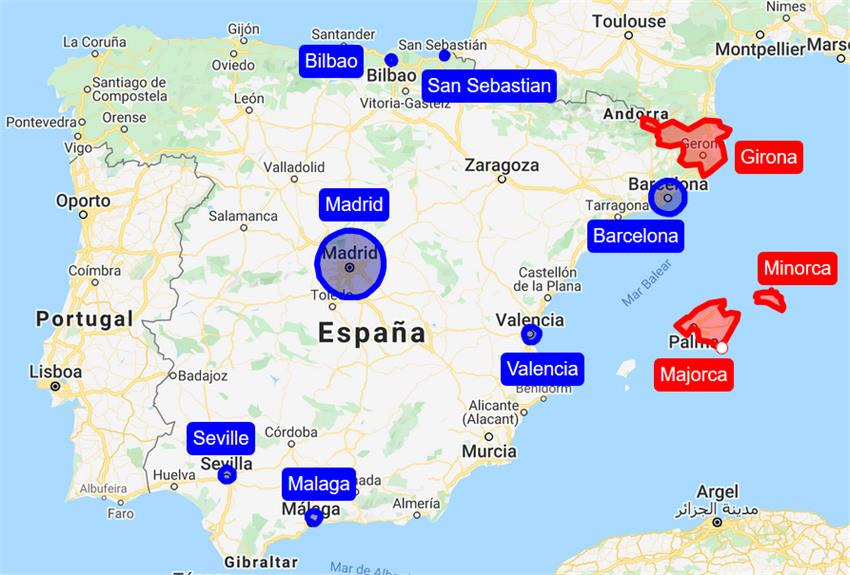
In Section 3.2, we analyze different characteristics of the Airbnb offer in ten Spanish cities or regions. These data were provided by insideairbnb.com, and cover the main tourist areas in Spain. We focus on analyzing cities (Madrid, Barcelona, Malaga, Seville, Valencia, San Sebastian and Bilbao), but islands and provincial areas are also included (Majorca, Menorca and Girona).
Figure 1. Spanish cities and regions examined
Source: compiled by the authors
We compare the four indicators mentioned above in the pre-pandemic context (specifically, in January 2020) and post-pandemic context (May 2020). We analyze the structural characteristics of the Airbnb sector (based on the pre-pandemic situation) and the very first reaction of the sector to the pandemic (see Tables 1 and 2). The following levels are analyzed: a) multi-listings by hosts as a percentage of all available listings; b) entire apartments as a percentage of all available listings; c) intensive use listings (so-called commercial listings in the referenced literature) as a percentage of all available listings; and d) the percentage of unavailable listings. The last three indicators are further examined both under the subsector of multi-listings and the subsector of single listings in order to compare any difference in behavior. The total number of listings is also shown.
In Section 3.3, the situation of Airbnb in Madrid is analyzed in depth. To ensure proper accounting of the actual offer at any given time, only the listings that are available at that particular time are taken into account. In contrast with Gil and Sequera (2020), we use all web scrapes available from insideairbnb.com and we check at each scraping date whether a particular listing was available or not. This is a much more accurate way of measuring the offer than the approach taken by Gil and Sequera, where the date of registration of a host is taken as the reference date for all of the listings managed by that host. This leads to inaccuracies because multi-listing hosts obviously do not post all listings at the same time. For instance, a tourist apartment manager that manages dozens of apartments and that has been active on the platform since 2016 has probably posted and taken down many listings from the platform at different times over the years. In addition, using data from a single web scrape gives a misleading impression of constant growth of Airbnb’s stock, since it overlooks any listings that have been taken down previously. The situation is clearly more complex than at first sight. Despite the number of listings available in Madrid having increased overall in the last 5 years, there have been times when the number of offers has fallen sharply.
3.2. Data
We use data from all the cities and regions available from the source insideairbnb.com and which cover the main tourist areas in Spain. We focus on analyzing cities (Madrid, Barcelona, Malaga, Seville, Valencia, San Sebastian and Bilbao), but also islands (Majorca, Menorca) and one provincial area (Girona). For all regions and cities, we use data from January 2020 and May 2020. In addition, for the city of Madrid, we use all data available from insideairbnb.com from July 2015 to July 2020 (monthly scrapes are performed starting in July 2018).
As mentioned above, these data allow us to calculate the following four indicators:
1. Percentage of multi-listings = # of hosts with multi-listings / # of available listings
2. Percentage of entire apartments = # of entire apartments listed / # of available listings
3. Percentage of intensive use listings = # of intensive use listings / # of available listings
4. Percentage of unavailable listings = # of unavailable listings / # of all listings
Multi-listing hosts are those that manage two or more listings, available listings are those that are available for rent for at least one day in the following year, intensive use listings are those that are available for more than 182 days per year, and unavailable listings are those not offered for rent a single day in the following year.
3.3. Comparative analysis of the impact of COVID-19
3.3.1. Grade of professionalization of Airbnb in Spain before COVID-19
Our main indicator to measure the level of professionalization of Airbnb in Spain is the percentage of multi-listings. In all locations, over half of the available listings belong to multi-listing hosts, as shown in Table 1. In Majorca 78.71% of total listings belong to multi-listing hosts, in Malaga 71.15% and in Seville 69.81%. In Bilbao the percentage of listings by multi-listing hosts is 50%, and in Madrid 59.91%.
The second indicator, the offer of entire apartments, shows very high percentages in some regions, such as Girona (93.07%), Menorca (92.71%), and Majorca (90.51%). In these cases, over 90% of the total Airbnb supply correspond to entire apartments. However, other areas, mainly cities, show a lower percentage of entire apartments, such as Barcelona (49.9%), Bilbao (52.42%), and Madrid (64.14%). This is consistent with the results of the study of Adamiak et al. (2019), who point out that entire apartment listings are concentrated in sun-and-beach areas, whereas private rooms are more common in big to medium-sized cities.
The third indicator, intensive use listings, shows percentages of over 50% in all cities and regions studied. The highest percentages of intensive use listings are seen in Majorca (78.71%), Malaga (71.15%) and Girona (68.08%).
Finally, the fourth indicator, the percentage of unavailable listings, is more prevalent in cities such as Madrid (19.28%), Bilbao (16.44%), Barcelona (14.43%) and San Sebastian (15.28%) than regions such as Majorca (5.23%) and Malaga (7.26%). Seville also had a very low percentage of unavailable properties advertised on Airbnb, representing only 5.83% of the total listings.
Table 1. Airbnb structure in 10 Spanish cities and regions pre-COVID-19 (all listings)
|
All listings |
# of listings |
% of multi-listings |
% of entire apartments |
% of intensive use |
% of unavailable listings |
|
Barcelona |
20708 |
68.53% |
49.90% |
59.09% |
14.43% |
|
Bilbao |
1235 |
50.00% |
52.42% |
50.48% |
16.44% |
|
Girona |
18673 |
68.08% |
93.07% |
64.47% |
11.17% |
|
Madrid |
21495 |
59.91% |
64.14% |
50.95% |
19.28% |
|
Malaga |
6297 |
71.15% |
84.79% |
63.54% |
7.26% |
|
Majorca |
17116 |
78.71% |
90.51% |
66.38% |
5.23% |
|
Menorca |
2820 |
65.54% |
92.71% |
58.02% |
8.51% |
|
San Sebastian |
1584 |
66.47% |
75.48% |
64.98% |
15.28% |
|
Seville |
6719 |
69.81% |
81.16% |
53.74% |
5.83% |
|
Valencia |
7261 |
57.15% |
67.98% |
+48.19% |
10.01% |
Source: compiled by the authors from Airbnb data from insideairbnb.com.
Table 2 groups the data from all cities and regions but differentiates between single listings and multi-listings. Multi-listings account for two thirds of the listings on offer. In general, multi-listings contain a slightly higher percentage of entire apartments, show a more intensive use and, in contrast to single listings, the percentage of unavailable listings is much lower. These results are consistent with our assumption of a higher level of professionalization among multi-listing hosts, since the non-professional hosts may be less diligent in taking down inactive listings.
Table 2. Airbnb structure pre-COVID-19 in Spain (single and multi-listings)
|
|
# of listings |
% of entire apartments |
% of intensive use |
% of unavailable listings |
|
Single listings |
35718 |
71.35% |
51.42% |
19.34% |
|
Multi-listings |
68190 |
76.54% |
62.35% |
8.02% |
Source: compiled by the authors from Airbnb data from insideairbnb.com.
3.3.2. Impact of COVID-19
In this section we describe how the Airbnb sector was affected by the COVID-19 pandemic in the 10 cities and regions analyzed (Table 3). Looking first at the percentage of multi-listings, only minor changes are seen. For example, in Mallorca 78% of total listings came from multi-listing hosts before and after COVID-19. In other cases, there are slight changes, as in Bilbao, where the percentage of listings from multi-listing hosts was 50% before the pandemic and 54% after the pandemic began.
Similarly, little change is seen in the percentage of entire apartments on offer, pre- and post-COVID-19. In the majority of cases, the percentage of entire homes or apartments advertised was slightly higher in the months after COVID-19: in Barcelona and in San Sebastian this increased by 2%. In other areas, such as Madrid and Majorca, however, it remained stable.
The percentage of intensive use listings reacted very differently following the initial impact of COVID-19. For example, in Girona and San Sebastian reductions of more than 11% were seen. In the case of Madrid, Barcelona, Seville and Bilbao, there were moderate increases of 3-4%.
The percentage of unavailable listings, which is probably one of the most accurate indicators for measuring the initial impact of COVID-19, showed substantial variations, with all the cities and regions studied showing a significant increase in unavailable listings following the pandemic. The biggest percentage increase was seen in the city of Seville, where unavailable listings grew from 5% to 15% of total listings. In Bilbao this percentage grew from 16% to 21%, and in Madrid, from 19% to 22%.
This fact could be interpreted as an initial response by some hosts who are not actively offering apartments or rooms but neither do they want to remove the listings from the platform.
Table 3. Airbnb structure changes post COVID-19 (all listings)
|
# of listings |
% of multi-listings |
% of entire apartments |
% of intensive use |
% of unavailable listings |
|
|
Barcelona |
+150 |
+1.14% |
+1.65% |
+3.77% |
+2.85% |
|
Bilbao |
+63 |
+4.29% |
+0.58% |
+3.11% |
+5.37% |
|
Girona |
+850 |
+0.75% |
+0.34% |
-11.71% |
+0.88% |
|
Madrid |
+244 |
+1.03% |
+0.38% |
+3.50% |
+3.62% |
|
Malaga |
-11 |
+0.11% |
+0.79% |
-0.20% |
+4.47% |
|
Majorca |
+412 |
-0.16% |
+0.23% |
-2.82% |
+2.53% |
|
Menorca |
+269 |
+0.29% |
-0.30% |
-3.20% |
+3.56% |
|
San Sebastian |
+4 |
-1.27% |
+1.68% |
-11.43% |
+4.75% |
|
Seville |
+5 |
-0.41% |
-0.54% |
+4.08% |
+9.44% |
|
Valencia |
+262 |
-0.01% |
-0.83% |
-0.11% |
+4.52% |
Source: compiled by the authors from Airbnb data from insideairbnb.com.
Table 4 shows the changes in percentages before and after the COVID-19 pandemic for single listings and multi-listings. The change is equally marginal in terms of the percentage of entire apartments in both cases. The intensive use percentage shows different behaviors; in the subsector of single listings it increases slightly while in the case of multi-listings it decreases to a greater extent. Finally, both in the case of multi-listings and that of single listings, the percentage of unavailable listings increases rapidly post-COVID-19, although to a greater extent among single listings.
Table 4. Airbnb structure changes post COVID-19 (single and multi-listings)
|
|
# of listings |
% of entire apartments |
% of intensive use |
% of unavailable listings |
|
Single listing |
+195 |
+0.66% |
+1.68% |
+4.07% |
|
Multi-listings |
+2053 |
+0.71% |
-2.67% |
+2.97% |
Source: compiled by the authors from Airbnb data from insideairbnb.com.
3.3. The evolution of the Airbnb sector in Madrid
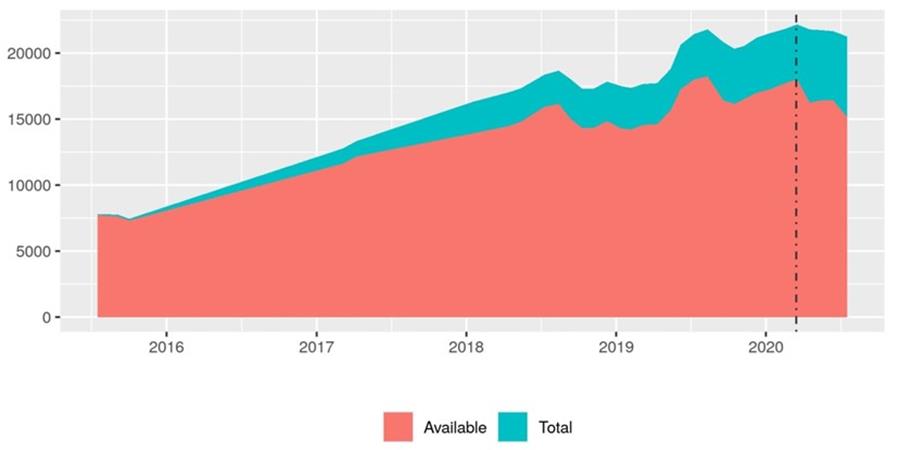
Graph 2 shows the total evolution of Airbnb's listings in Madrid, the capital of Spain; in particular, the evolution of total and available listings in Madrid in the period 2015-2020. On March 17th, 2020, before the onset of the COVID-19 pandemic, which severely hit Madrid, the city had a total offer of 22170 listings, with 18019 of them being available. Four months after the outbreak of the pandemic, active listings dropped to 15159, showing a decrease of 15.87%.
Graph 2. Evolution of total and available listings in Madrid (2015-2020).
Source: compiled by the authors from Airbnb data from insideairbnb.com.
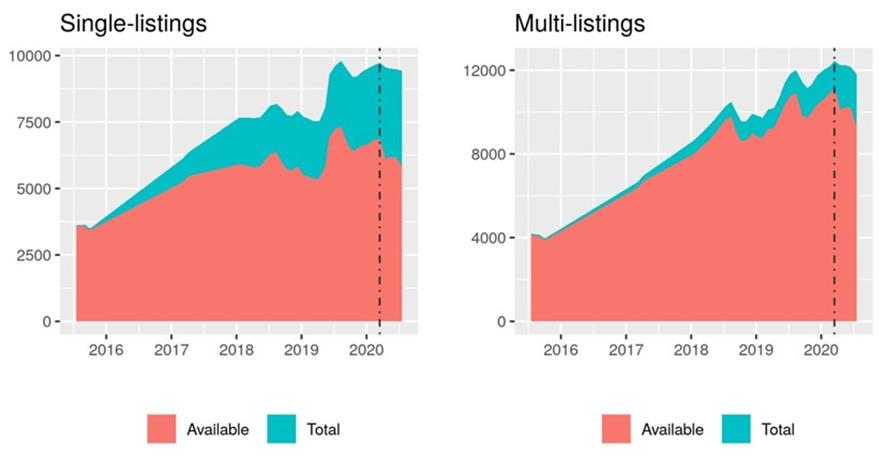
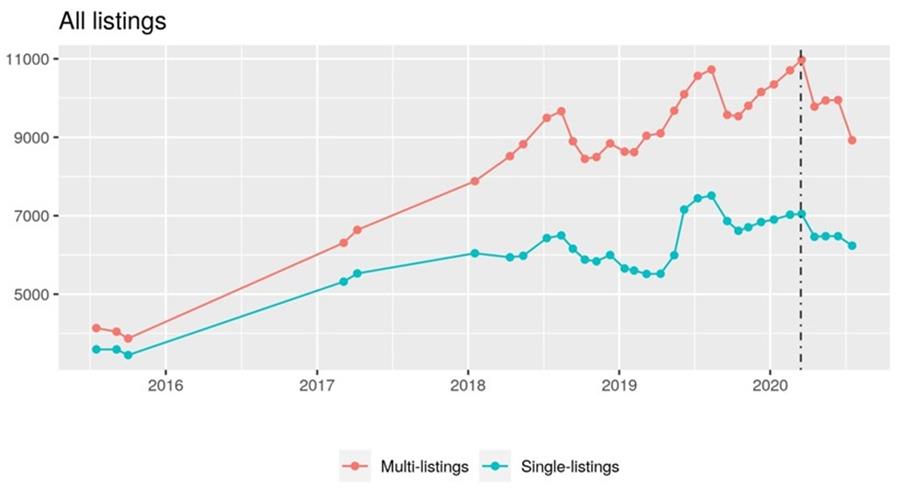
With reference to the typology of hosts (first indicator), if we observe the behavior of the single listings versus the multi-listings, the difference is very noticeable (Graph 3). The offer that is most compatible with a P2P approach, i.e., that of single listings, has grown moderately in recent years. With 3700 listings available in 2015, the number grew to around 6000 by mid-2019, and despite a strong increase in the spring of that year, the number stabilized to under 7000 before the the COVID-19 pandemic. However, a more remarkable growth is seen in the supply offered by multi-listing hosts. While in 2015 the supply of single listings and multi-listings was similar, the number of multi-listings doubled in 2018 and continued to grow to a maximum peak of around 10957 listings before the appearance of COVID-19. This uneven behavior, therefore, indicates a possible evolution towards a more professionalized offer.
Graph 3. Evolution of total and available single listings and multi-listings in Madrid (2015-2020).
Source: compiled by the authors from Airbnb data from insideairbnb.com.
This difference in evolution is shown in Graph 4. While in 2015 and 2017 numbers were similar, the stock of multi-listings has since increased rapidly, reaching about 1.5 times the number of single listings in 2020. The reaction to COVID-19 in both types of listings was quite similar, with a sharper decrease seen in multi-listings in July.
Graph 4. Evolution of the number of multi-listings and single listings on Airbnb in Madrid (2015-2020).
Source: compiled by the authors from Airbnb data from insideairbnb.com.
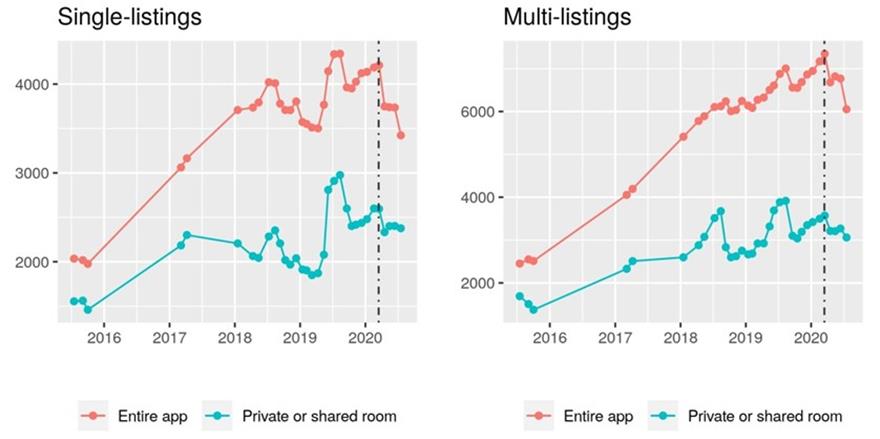
As stated above, the second indicator for analyzing the degree of professionalization of Airbnb's offer is the type of property available. A greater presence of entire apartments being listed indicates non-compliance with the "access economy" principle explained in the theoretical framework. In the case of Madrid, among the total number of listings, the number of entire apartments is double that of rooms. This imbalance is slightly greater among the multi-listing offers. In March 2020, 61.4% of single listings offered entire apartments compared to 65.6% of multi-listings. As Graph 5 shows, the decrease of stock after March 2020 is notable among entire apartments for both single and multi-listings.
Graph 5. Number of entire apartments offered on Airbnb in Madrid (2015-2020).
Source: compiled by the authors from Airbnb data from insideairbnb.com.
As a third indicator, a further measure related to the greater professionalization of listings on Airbnb is the intensity of use of the properties advertised.
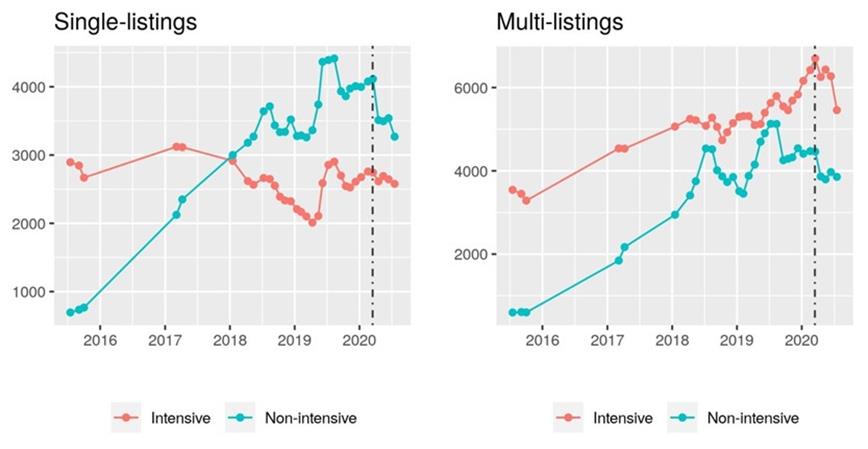
In this case, the behavior differs greatly between single listings and multi-listings (Graph 6). For single listings, since 2018 the offer of non-intensive accommodation (available for less than 183 days per year) has exceeded the intensive offer. Although the curve of the evolution of non-intensive listings is similar among multi-listings, the offer of intensive use listings has increased significantly in recent years. Thus, we can see that multi-listing hosts tend to offer apartments more intensively, showing a trend towards a more professional behavior on the platform.
Graph 6. Percentage of intensive use listings on Airbnb in Madrid (2015-2020).
Source: compiled by the authors from Airbnb data from insideairbnb.com.
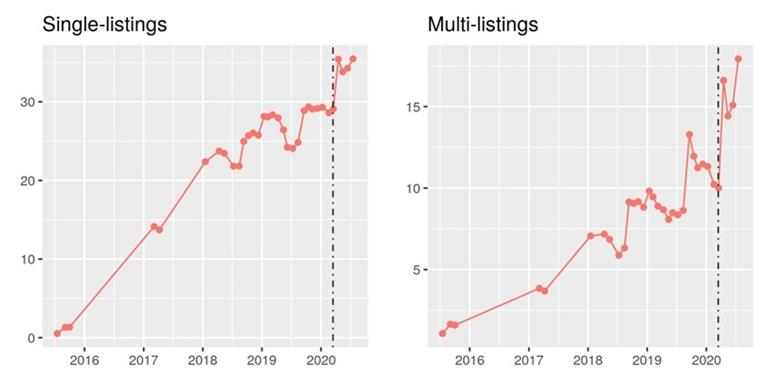
Finally, as a fourth indicator, we analyze the evolution of the percentage of listings registered on Airbnb but unavailable (Graph 7). We call a listing unavailable if it is not offered for a single day in the year following the scraping date. Not surprisingly, the rate grows over time as a result of the cumulative effect of inactive listings that are not removed from the website.
Proportionally, the evolution is similar among both single listings and multi-listings. The most interesting aspect in this case is the immediate reaction to the outbreak of COVID-19 in early 2020. In both cases there was a sudden increase in inactive adverts, i.e., hosts that completely removed the offer of their accommodation from the Airbnb availability calendar. After this initial reaction, the evolution seems to have been contained in the case of single listings but not in the case of multi-listings.
Graph 7. Percentage of unavailable listings on Airbnb in Madrid (2015-2020).
Source: compiled by the authors from Airbnb data from insideairbnb.com.
4. Discussion
The results of the descriptive analysis regarding 10 Spanish cities and regions show that the structure of Airbnb's offer is very different from the idea of individuals earning a little extra money through the exchange of their houses or rooms. Even before the COVID-19 pandemic, all major Spanish tourist destinations showed more than half of the listings on Airbnb to be multi-listings. In 7 of the 10 destinations analyzed, more than two thirds of the advertisements published were from hosts with multi-listings.
Furthermore, the vast majority of the properties offered in the main Spanish tourist destinations are seen to be entire apartments (over 90% in several cases), which means a lack of socialization with no shared spaces, suggesting the community aspect of the exchange is clearly not reinforced by coexistence and cultural exchange.
This structure of supply shows that the supposed benefits of the sharing economy are not often present in the case of the Airbnb platform, since multiple supply based on entire apartments is not compatible with supply between individuals nor with a community approach (Gil and Sequera, 2020).
The Airbnb sector in Spain, therefore, does not comply with the principles of the sharing economy (access economy; platform economy; and community-based economy). Firstly, the analysis carried out clearly shows that many of the hosts have multi-listings and that some of the single listings do not have days marked as unavailable which could be an indicator of a higher presence of commercial or professional agents on the Spanish Airbnb platform. This suggests that these properties are not properties that are under-used and need to be optimized, but rather investments from which to obtain economic returns.
Secondly, a large percentage of multi-listings and single listings have no days marked as unavailable. Airbnb generates a meeting place between supply and demand but does not seek to generate a community project. Professionalization tells us that hosts approach the platform in search of economic returns and not with the concept of community in mind (Mair and Reschauer, 2017). Community seems to be linked to a secondary logic that is always subordinated to commercial interests, and this logic is clearly apparent on the Airbnb platform in Spain.
Finally, it is clear that Airbnb is a digital platform which provides a meeting place between supply and demand, as in Spain. It therefore complies with the principle of the platform economy as “a set of initiatives that mediate decentralized exchanges among peers through digital platforms” (Acquier et al., 2017: 5).
But is it really decentralized? Although the collaborative economy is presented as the alternative to centralized markets in political and economic institutions controlled by bureaucracy and professions (Acquier et al., 2017), the data seem to show that the Airbnb platform is being controlled by professionals.
Airbnb is clearly not linked to the concept of the social economy. In addition to being a private capitalist platform, the ultimate agents involved are commercial or professional for-profit companies, and thus the platform is linked to a commercial logic and not to a community logic.
The emergence of COVID-19 has not substantially changed the structure of the Airbnb sector, as the percentage of listings coming from multi-listing hosts shows. If anything, the degree of professionalization of the Airbnb sector has been slightly reinforced, since in some cities and regions this percentage has increased slightly. Therefore, the profile of Airbnb can be considered a consolidated structure, since the overall decline in tourism flows caused by the pandemic hardly affected it´s main parameters.
This analysis of the initial post-COVID-19 reaction by the sector (which shows an apparent stability) is the main contribution of our paper. Nevertheless, this paper also provides the incorporation of another dimension that has been little explored in the academic studies to date: the degree of availability of the listings. This refers to listings that are still active on the platform but that do not offer open availability for the ensuing months.
This final variable illustrates how responses of Airbnb operators evolved from their initial reactions within the broader context of the pandemic. Across all regions and cities, there was a notable surge in unavailable listings. For instance, the percentage of unavailable listings in Seville suffered a significant increase from 5% to 15% of the total listings.
In fact, it is interesting to note that multi-listing hosts consistently exhibit lower unavailability rates. This aligns with the more commercial nature of this professionalized subset within the sector. However, we observe that the impact of the pandemic triggered a similar initial response among both multi-listings and single-listing hosts. This similarity might hint at a substantial presence of commercial or professional operators even among single-listing hosts.
The evidence presented above would confirm the first objective of this study related to the measurement of the grade of professionalization; that operations with a commercial basis, managed by professional agents, are more prominent on the Airbnb platform than it was first thought. The whole multi-listings subsector, but also part of the single-listings subsector, may be involved in professionalization of the platform.
Results regarding the second objective, measuring the reaction of hosts to the impact of COVID-19 on the Airbnb sector, show that for single-listings/multi-listing hosts, the level of unavailability rates and the other indicators studied all had similar rates among different agents.
The third objective is related to a methodological improvement. We analyzed the structural situation of Airbnb in Madrid over the last 5 years, using the indicators proposed by Gil and Sequera (2020), adding unavailability as a fourth indicator. We refined the methodological approach and revealed a more complex reality than the one described previously. Furthermore, analysis of the availability of Airbnb listings in Madrid enabled us to extend the study further, in addition to observing the immediate response to COVID-19 by the supply side as described above.
5. Conclusions
Tourism has undergone a major expansion in recent years, with the number of trips and overnight stays increasing considerably. On a qualitative level, the 2010 decade saw a transformation in the lodging sector, with the rise of informal models of accommodation offered through exchange platforms (profit and non-profit).
The rise and success of platforms such as Airbnb have completely transformed the rules of the game in the tourism sector. A characteristic of this sector is its sensitivity to changes in the environment and its capacity to adapt rapidly. The entry of informal accommodation models has forced adaptation dynamics on the part of various actors.
However, the appearance of the COVID-19 global pandemic in 2020 shook the foundations of this sector. The threat was sudden and far-reaching, with the tourism sector almost totally paralyzed in most parts of the world. The immediate effects were evident, but it remains to be seen whether we are facing long-term structural transformations in the sector.
Travellers demand confidence and security on their holidays, and this reassurance is fundamental for promoting Airbnb-type platforms. With the health threat adding to other factors of mistrust, an assessment of the effect of the pandemic in the medium and long term is necessary, both for its impact on global tourism flows as well as for the future development of the Airbnb sector. Having faced a pandemic, the tourism sector, and within this Airbnb, must now remain open to the necessary changes to ensure their clients feel confident when travelling and choosing accommodation in the future.
In this paper we study the structure of the Airbnb offer, which is clearly undergoing a process of professionalization, and we have observed the immediate and short-term reaction of the Airbnb supply to the COVID-19 pandemic. A large part of the existing offer on the Airbnb platform does not comply with the basic principles of the sharing economy and therefore cannot be linked to the social economy. The immediate response seen in the months following the pandemic also reinforces the image of professionalization among Airbnb's listings. One limitation of this study is that it was completed using data from the time of the COVID-19 pandemic. It would, therefore, be necessary to replicate similar studies in other contexts and, above all, at a future date. In this way, it would be possible to assess whether the effect of the pandemic on the tourism sector and on the supply offered by the Airbnb platform was just temporary or has structurally transformed the platform.
Funding: This study was supported by the research group on Social Economy and its Law IT1711-22.
Author Contributions: Conceptualization, J.M.-A., I.M. , J.I.-O. and A.E.-E.; Methodology, I.M.; Software, I.M.; Validation, J.M.-A., I.M. , J.I.-O. and A.E.-E.; Formal Analysis, I.M.; Investigation, J.M.-A., I.M. , J.I.-O. and A.E.-E.; Resources, J.I.-O. and J.M.-A.; Data Curation, I.M. and J.M.-A.; Writing—Original Draft Preparation, J.M.-A., I.M. , J.I.-O. and A.E.-E.; Writing—Review & Editing, J.M.-A. and I.M.; Visualization, J.I.-O. and J.M.-A.; Supervision, J.M.-A., I.M. , J.I.-O. and A.E.-E.; Project Administration, J.I.-O. and A.E.-E.; Funding Acquisition, J.I.-O. and A.E.-E.. All authors have read and agreed to the published version of the manuscript.
Conflicts of Interest: The authors declare no conflict of interest.
6. References
Abhari, K., Davidson, E. J. and Xiao, B. (2019) Collaborative innovation in the sharing economy: Profiling social product development actors through classification modeling. Internet Research, 29(5), pp. 1014-1039.
Acquier, A., Daudigeos, T. and Pinkse, J. (2017) Promises and paradoxes of the sharing economy: An organizing framework. Technological Forecasting and Social Change, 125, pp. 1-10.
Adamiak, C. (2022) Current state and development of Airbnb accommodation offer in 167 countries. Current Issues in Tourism, 25(19), pp. 3131-3149.
Adamiak, C., Szyda, B., Dubownik, A., and García-Álvarez, D. (2019) Airbnb offer in Spain – Spatial Analysis of the pattern and determinants of its distribution. International Journal of Geo-Information, 8, pp. 155.
Alonso, R. (2016) Economía colaborativa: un nuevo mercado para la economía social. CIRIEC-España, Revista de Economía Pública, Social y Cooperativa, Nº 88, pp. 230-258.
Ayouba, K., Breuillé, M. L., Grivault, C. and Le Gallo, J. (2020) Does Airbnb Disrupt the Private Rental Market? An Empirical Analysis for French Cities. International Regional Science Review, 43(1–2), pp. 76-104.
Barnes, S. J., & Mattsson, J. (2016) Understanding current and future issues in collaborative consumption: A four-stage Delphi study. Technological Forecasting and Social Change, 104, pp. 200-211.
Barron, K., Kung, E. and Proserpio, D. (2018) The sharing economy and housing affordability: Evidence from Airbnb. Available at: https://ssrn.com/abstract=3006832 (accessed 30 April 2021).
Barron, K., Kung, E., and Proserpio, D. (2021) The effect of home-sharing on house prices and rents: Evidence from Airbnb. Marketing Science, 40(1), pp. 23-47.
Bauwens, M., Mendoza, N. &, Iacomella, F. (2012) A Synthetic Overview of the Collaborative Economy.[report] Orange Labs and P2P Foundation.
Belarmino, A. and Koh, Y. (2020) A critical review of research regarding peer-to-peer accommodations. International Journal of Hospitality Management, 84, pp. 102315.
Belk, R. (2014) Sharing Versus Pseudo-Sharing in Web 2.0. Anthopologist, 18(1), pp. 7-23.
Benkler, Y. (2004) Sharing Nicely: On Shareable Goods and the Emergence of Sharing as a Modality of Economic Production. Yale Law Journal, 114, pp. 273-358.
Botsman, R., and Rogers, R. (2010) Beyond zipcar: Collaborative consumption. Harvard business review, 88(10), pp. 30.
Camilleri, J. and Neuhofer, B. (2017) Value co-creation and co-destruction in the Airbnb sharing economy. Contemporary Hospitality Management, 29(9), pp. 2322-2340.
Campbell, M., McNair, H., Mackay, M. and Perkins, H.C. (2019) Disrupting the regional housing market: Airbnb in New Zealand. Regional Studies, Regional Science, 6(1), pp. 139-142.
Cañigueral, A., Ortiz, N. and Léonard, A. (2012) Trust is the new currency. Trust design: Public trust, 4, pp. 15-19.
Chaves, R. and Monzón, J.L. (2018) La economía social ante los paradigmas económicos emergentes: innovación social, economía colaborativa, economía circular, responsabilidad social empresarial, economía del bien común, empresa social y economía solidaria. CIRIEC-España, Revista de Economía Pública, Social y Cooperativa, Nº 93, pp. 5-50.
Cheng, M. and Foley, C. (2020) The sharing economy and digital discrimination. International Journal of Hospitality Management, 70, pp. 95-98.
Codagnone, C., Biagi, F. and Abadie, F. (2016) The Passions and the Interests: Unpacking the ‘Sharing Economy. JCR Science for Policy Report, European Commission https://publications.jrc.ec.europa.eu/repository/handle/JRC101279.
Cor - European Committee of the Regions (2016) Opinion of the European Committee of the Regions — The Local and Regional Dimension of the Sharing Economy. Official Journal of the European Union, 10.02.2016, C 51/28.
Dabija, D.-C.; Csorba, L.M.; Isac, F.-L.; Rusu, S. (2022) Building Trust toward Sharing Economy Platforms beyond the COVID-19 Pandemic. Electronics, 11(18), pp. 2916.
De Vaujany, F.X., Leclercq-Vandelannoitte, A. and Holt, R. (2019) Communities versus platforms: The paradox in the body of the collaborative economy. Journal of Management Inquiry. https://doi.org/10.1177/1056492619832119.
Dredge, D. and Gyimóthy, S. (2015) The collaborative economy and tourism: critical perspectives, questionable claims and silenced voices. Tourism Recreation Research, 40(3), pp. 286-302.
Etxezarreta-Etxarri, A., Izagirre-Olaizola, J., Morandeira-Arca, J. and Mozo Carollo, I. (2020) Urban touristification in Spanish cities: consequences for the rental-housing sector in San Sebastian. Economic Research – Ekonomska Istrazivanja, 33(1), pp. 1294-1310.
García-López, M.-À., Jofre-Monseny, J., Martínez-Mazza, R. and Segú, M. (2020) Do short-term rental platforms affect housing markets? Evidence from Airbnb in Barcelona. Journal of Urban Economics, 119, 103278.
Gil, J. and Sequera, J. (2018) Expansión de la ciudad turística y nuevas resistencias. El caso de Airbnb en Madrid. Empiria: Revista de Metodología de Ciencias Sociales, 41, pp. 15-32.
Gil, J. and Sequera, J. (2020) The professionalization of Airbnb in Madrid: far from a collaborative economy. Current Issues in Tourism, https://doi.org/10.1080/13683500.2020.1757628 (accessed 30 April, 2021).
Gössling, S., Scott, D. and Hall, C.M. (2020) Pandemics, tourism and global change: a rapid assessment of COVID-19. Journal of Sustainable Tourism. https://doi.org/10.1080/09669582.2020.1758708 (accessed 30 April, 2021).
Gurran, N. and Phibbs, P. (2017) When tourists move in: How should urban planners respond to Airbnb? Journal of the American Planning Association, 83(1), pp. 80-92.
Gurran, N., Zhang, Y. and Shrestha, P. (2020) ‘Pop-up’ tourism or ‘invasion’? Airbnb in coastal Australia. Annals of Tourism Research, 81, pp. 102845.
Guttentag, D. (2015) Airbnb: disruptive innovation and the rise of an informal tourism accommodation sector. Current Issues in Tourism, 18(12), pp. 1192-1217.
Gutierrez, J., Garcia-Palomares, J.C., Romanillos, G. and Salas-Olmedo, M.H. (2017) The eruption of Airbnb in tourist cities: Comparing spatial patterns of hotels and peer-to-peer accommodation in Barcelona. Tourism management, 62, 278-291.
Hasan, R., and Birgach, M. (2016, June) Critical success factors behind the sustainability of the Sharing Economy. In 2016 IEEE 14th International Conference on Software Engineering Research, Management and Applications (SERA) (pp. 287-293). IEEE.
Hernandez-Carrion, J. R. (2022) Deconstruyendo la 'peer-to-peer sharing economy': El desafío de la economía colaborativa a las cooperativas de plataforma en la era del pos-trabajo del siglo XXI. CIRIEC España: Revista de Economia Publica, Social y Cooperativa, Nº 105, pp. 177-204.
Horn, K. and Merante, M. (2017) Is Home Sharing Driving Up Rents? Evidence from Airbnb in Boston. Journal of Housing Economics, 38, pp. 14-24.
Hossain, M. (2020) Sharing economy: A comprehensive literature review. International Journal of Hospitality Management, 87, pp. 102470.
Ikkala, T. and Lampinen, A. (2015). Monetizing network hospitality: Hospitality and sociability in the context of Airbnb. In Proceedings of the 18th ACM conference on computer supported cooperative work & social computing, pp. 1033–1044.
Ingram, M. (2012) Airbnb, Coursera, and Uber: The rise of the disruption economy. Bloomberg Business, 25, http://www.bloomberg.com/bw/articles/2012-10-25/airbnb-coursera-and-uber-the-rise-of-the-disruption-economy (accessed 30 April, 2021).
Inside Airbnb. (s. f.). Inside Airbnb: Adding data to the debate. http://insideairbnb.com/.
Kwok, L. and Xie, K. (2020) Pricing strategies on Airbnb: Are multi-unit hosts revenue pros? International Journal of Hospitality Management, 82, pp. 252-259.
Lampinen, A. and Cheshire, C. (2016) Hosting via Airbnb: Motivations and financial assurances in monetized network hospitality. CHI'16 proceedings of the 2016 CHI conference on human factors in computing systems. New York, NY: ACM.
Lee, D. (2016) How Airbnb short-term rentals exacerbate Los Angeles’s affordable housing crisis: Analysis and policy recommendations. Harvard Law & Policy Review, 10, pp. 229–253.
Lerena, N. and Rodriguez, L. (2023) Airbnb in Latin America: A literature review from an urban studies perspective. Journal of Urban Affairs, pp. 1-15.
Light, A. and Miskelly, C. (2019) Platforms, scales and networks: Meshing a local sustainable sharing economy. Computer Supported Cooperative Work, 28, pp. 591-626.
Lowitt, E. (2013) The collaboration economy: How to meet business, social, and environmental needs and gain competitive advantage. John Wiley & Sons.
Mair, J. and Reischauer, G. (2017) Capturing the dynamics of the sharing economy: Institutional research on the plural forms and practices of sharing economy organizations. Technological Forecasting and Social Change. 125, pp. 11-20.
Martin CJ. 2016. The sharing economy: a pathway to sustainability or a nightmarish form of neoliberal capitalism? Ecological economics, 121, pp. 149-159.
Matzler, K.; Veider, V.; Kathan, W. (2015) Adapting to the sharing economy. MIT Sloan Management Review, 56(2), pp. 71–77.
Mhlanga, O. (2019) Peer-to-peer-travel: is Airbnb a friend or foe to hotels?. International Journal of Culture, Tourism and Hospitality Research, 13(4), pp. 443-457.
Monzón, J.L. and Chaves, R. (2017) Recent evolutions of the Social Economy in the European Union. Brussels: European Economic and Social Committee.
Moreno, L., Ramón, A. and Such, M.J. (2016) Turismo colaborativo: ¿Está Airbnb transformando el sector del alojamiento? Economistas, 150, pp. 107-119.
Mozo, I., Morandeira-Arca, J., Etxezarreta-Etxarri, A. and Izagirre-Olaizola, J. (2023) Is the effect of Airbnb on the housing market different in medium-sized cities? Evidence from a Southern European city. Urban Research & Practice, pp. 1-20.
Munar, A.M. and Gyimóthy, S. (2013) Critical Digital Tourism Studies. In: Munar, Ana María, Szilvia Gyimóthy and Liping Cai (eds.). Tourism Social Media: Transformations in Identity, Community and Culture. Tourism Social Science Series, 18, pp. 245-262.
Muñoz, P. and Cohen, B. (2017) Mapping out the sharing economy: A configurational approach to sharing business modeling. Technological Forecasting and Social Change, 125, pp. 21-37.
Palos-Sanchez, P. R., and Correia, M. B. (2018) The collaborative economy based analysis of demand: Study of Airbnb case in Spain and Portugal. Journal of theoretical and applied electronic commerce research, 13(3), pp. 85-98.
Pazaitis, A., De Filippi, P. and Kostakis, V. (2017) Blockchain and value systems in the sharing economy: The illustrative case of Backfeed. Technological Forecasting and Social Change, 125, pp. 105-115.
Pizam, A. (2014) Peer-to-peer travel: Blessing or blight? International Journal of Hospitality Management, 38, pp. 118-119.
Quattrone, G., Proserpio, D., Quercia, D., Capra, L. and Musolesi, M. (2016) Who benefits from the sharing economy of Airbnb? Proceedings of the 25th International Conference on World Wide Web. International World Wide Web Conferences Steering Committee, pp. 1385-1394
Retamal, M. L. and Dominish, E. (2017) The sharing economy in developing countries. Institute for Sustainable Futures at the University of Technology Sydney (UTS).
Rodríguez-Pérez de Arenaza, D., Hierro L. A., & Patiño, D. (2022). Airbnb, sun-and-beach tourism and residential rental prices. The case of the coast of Andalusia (Spain). Current Issues in Tourism, 25(20), pp. 3261-3278.
Rojanakit, P., de Oliveira, R. T. and Dulleck, U. (2022) The sharing economy: A critical review and research agenda. Journal of Business Research, 139, pp. 1317-1334.
Sainaghi, R. (2020) The current state of academic research into peer-to-peer-accommodation platforms. International Journal of Hospitality Management, 84, pp. 102555.
Sarkar, A., Koohikamali, M. and Pick, J. B. (2020) Spatial and socioeconomic analysis of host participation in the sharing economy: Airbnb in New York City. Information Technology and People, 33(3), pp. 983–1009.
Sengupta, P., Biswas, B., Kumar, A., Shankar, R. and Gupta, S. (2021) Examining the predictors of successful Airbnb bookings with Hurdle models: Evidence from Europe, Australia, USA and Asia-Pacific cities. Journal of Business Research,137, pp. 538-554.
Schor, J. (2016) Debating the sharing economy. Journal of Self-Governance and Management Economics. 4(3), pp. 7-22.
Tamilmani, K., Rana, N. P., Nunkoo, R., Raghavan, V. and Dwivedi, Y. K. (2022) Indian Travellers’ Adoption of Airbnb Platform. Information Systems Frontiers, pp. 1-20.
Todd, J., Musah, A. and Cheshire, J. (2021) Assessing the impacts of Airbnb listings on London house prices. Environment and Planning B: Urban Analytics and City Science, 49(1), pp. 206-222.
Tong, B. and Gunter, U. (2022) Hedonic pricing and the sharing economy: how profile characteristics affect Airbnb accommodation prices in Barcelona, Madrid, and Seville. Current Issues in Tourism, 25(20), pp. 3309-3328.
Tran, T.H. and Viachaslau Filimonau, V. (2020) The (de)motivation factors in choosing Airbnb amongst Vietnamese consumers. Journal of Hospitality and Tourism Management, 42, pp. 130-140.
Tseng, Y.-C., and Chan, C.-L. (2021) When the Sharing Economy Meets Established Institutions: Uber and Airbnb in Taiwan. IEEE Transactions on Engineering Management. 68(6), pp. 1895-1906.
Visser, G., Erasmus, I. and Miller, M. (2017) Airbnb: The Emergence of a New Accommodation Type in Cape Town. South Africa Tourism Review International, 21(2), pp. 151-168.
Von der Heidt, T., Muschter, S., Caldicott, R. and Che, D. (2020) Airbnb in the Byron Shire, Australia – bane or blessing?. International Journal of Tourism Cities, 6(1), pp. 53-71.
Wachsmuth, D.A.W. (2018) Airbnb and the rent gap: Gentrification through the sharing economy. Environment and Planning A: Economy and Space, 50(6), pp. 1147-1170.
Walensky, R.P. and Del Rio, C. (2020) From mitigation to containment of the COVID-19 pandemic: Putting the SARS-CoV-2 genie back in the bottle. JAMA.
Walsh, B. (2011) Today’s Smart Choice: Don’t Own, Share. Time International, Atlantic ed., March 28.
Wang, H., and Yang, H. (2019) Ridesourcing systems: A framework and review. Transportation Research Part B: Methodological, 129, pp. 122-155.
WHO (2020) Coronavirus disease 2019 (COVID-19) Situation Report. World Health Organization. https://www.who.int/emergencies/diseases/novel-coronavirus-2019/situation-reports.
Zale, K. (2016) When everything is small: the regulatory challenge of scale in the sharing economy. San Diego L. Rev., 53, pp. 949.
Zeng, B., Carter, R.W. and De Lacy, T. (2005) Short-term Perturbations and Tourism Effects: The Case of SARS in China. Current Issues in Tourism, 8(4), pp. 306-322,
Zervas, G., Proserpio, D. and Byers, J.W. (2017) The rise of the sharing economy: Estimating the impact of Airbnb on the hotel industry. Journal of Marketing Research. https://doi.org/10.1509/jmr.15.0204 (accessed 30 April, 2021).